Category Archives: Shit theory

Shit index

So here we are. Shit theory’s growing taxonomy is up to seven shits:

  • Chickenshit — “tedious nonsense — all the formalities, procedures, reports, busywork and minutiae that ruins everyday existence — that seem like it ought to add up to something important but never does..”
  • Bullshit — “meaning-mongering nonsense — notions that seem overflowing with promise, benevolence and idealistic intention — but which can never be achieved, or even put into practice.”
  • Horseshit — “malevolent nonsense — artifacts of ignorant, paranoid resentment meant to answer the eternal question ‘who can we blame for this shitshow?’”
  • Birdshit — “meta nonsense — the little condescending golden turds of pseudowisdom dropped from above by high-flying assholes, soaring on the conceit that abstract theorizing somehow raises us above the stubborn concreteness of the human condition..”
  • Dogshit — “incompetent nonsense — the result of nondesigners who think they are designers trying to design and bungling it, and then repeating the bungling as rapidly and randomly as possible.”
  • Apeshit — “weaponized nonsense — any lump of ideas picked up and hurled as a projectile.”
  • Batshit — “crazy nonsense — the byproduct of an urgent and failed need to make sense of things that are not even real — at least according to all you “sane” people.”

What else is there, even? Catshit? Ratshit? I don’t even know if they’re needed. I think this might be a complete list. If so shit studies reached its apex within 72 hours of its founding. That’s a pretty squat shitheap, given the overwhelming quantity of shit out there.

Batshit

Another extremely important shit species that deserves analysis is batshit.

When someone believes things beyond belief, and believes them elaborately, intricately, extravagantly and urgently, we call that person batshit crazy.

Often, these beyond-belief beliefs are literally about the beyond. They are speculative. But the speculation has taken on a life of its own, and is no longer obviously speculation about reality. The speculations have detached and become a standalone batshit world, which feels way more real and interesting than whatever that other world was.

Batshit is sometimes confused with bullshit, because batshit is nonsense that never touches ground and has no practical effectiveness. But unlike bullshit, batshit is believed, intensely and sincerely. And while both bullshit and batshit fail to translate ideas into effective practices, bullshit never tries, whereas batshit ideas lead directly to batshit practices.

And it is also easy to confuse batshit with birdshit, in that it flies around in the sky. But where birdshit flies into the sky to get a better, loftier, critical look at the ground in order to shit all over it, batshit is trying to fly further than the sky, and the batshit produced in the effort is innocent byproduct, forgotten as soon as it falls into that nowhere known as solid ground.

“Batshit” is crazy nonsense — the byproduct of an urgent and failed need to make sense of things that are not even real — at least according to all you “sane” people.

Apeshit

I mentioned apeshit in passing in an earlier shit theory installment. But it deserves its own definition.

When we human primates get really super-fucking angry, something horrible and funny happens to us. We lose access to the newfangled lobes of our hypertrophied brains, we begin to resemble our animal kingdom relatives.

We do what they do. We grab whatever is closest at hand and fling at whoever has infuriated us. We go apeshit.

Shit studies scholars call whatever is flung in this state apeshit. Whatever kind of shit it started out as, once it is picked up and hurled, it is now classified as apeshit.

“Apeshit” is weaponized nonsense — any lump of ideas picked up and hurled as a projectile. The point of it is not truth, or ideas, or anything resembling communication. It is pure animal speech act.

Apeshit is not about content. Blunt force impact is the message. It is about impact, and a disgusting, degrading mess to clean up.

Dogshit

I was shooting the shit with my brother Scott, and he raised a crucial question. When would I address the issue of dogshit?

How about now?

I am a designer by profession, which is why I am angry nearly all the time.

One of the worst things about this being a designer, besides the usual chickenshit, is one particularly noxious bit of bullshit, that I’m pretty sure nobody else has to deal with.

That bullshit is the deeply untrue insistence that “everyone is a designer.”

I don’t see other professionals running around assuring everyone that they can do their job.

And this bullshit invites people to do our jobs instead of us. Tragically, thanks to the maleficent magic of metacognitive incompetence, aka Dunning-Kruger, aka double-ignorance, they are unable to notice how much worse at design they are than designers.

This happened with “design thinking” when business executives actually believed designers and decided that learning a bunch of chickenshit techniques would help them solve a bunch of bullshit problems. “HMW we waste our time leveraging methods we have no business messing with, on problems nobody really cares about?” Design Thinking, that’s how!

And it happened again with product management. A bunch of clever, incompetent jacks-of-all-trades with MBAs who learned to talk like engineers decided to reinvent strategic design from scratch as if design never existed because this was a job far too important to let designers do.

The result of these efforts is pure dogshit.


“Dogshit” is incompetent nonsense — the result of nondesigners who think they are designers trying to design and bungling it, and then repeating the bungling as rapidly and randomly as possible. They call the repetition “iteration” and their bungling “failing fast” or “moving fast and breaking things” or “discovery”, missing the point that things are supposed to move steadily toward improvement, not just spasm every which way in perpetual brokenness.


I suppose we could expand the definition of dogshit to cover more takeovers of professions by hordes of incompetents. We could discuss how ideologues have invaded the humanities, or activists have taken over journalism, education and entertainment media, professional marketers have displaced artists, ?and just about everybody and their cousin cranking out vibecoded dogshit apps… ?and so on.

But I am the author of Shit Theory, and as far as I’m concerned, I’m nailing the shit out of it.

Birdshit

My friend Jim graciously read my post on Shit Theory.

But it left him with a question: “Do you really believe Shit Theory can carry us over this rising flood of shit?”

I answered, “Of course not. That claim is total bullshit.”

“Nothing will save us,” I added. “We are all going to die.”

But then it hit me: My claim was not bullshit. It was something else entirely.

Jim had identified an entire new species of shit: birdshit.

My claim that understanding Shit Theory will somehow save us from drowning in shit is not only untrue, it dumps an entirely new ocean of shit into the already unfathomably shitty depths of bullshit, chickenshit and horseshit.

Here is the truth: No theoretical understanding of a shitty practical situation does shit to help us fix it. And believing that it does only makes things worse.

We are in deep shit, and Shit Theory’s birdshit claim of making it all better through the power of understanding only deepens the deep shit we are in.

The only way Shit Theory makes anything better is the feeble, overrated medicine of laughter. Any claims to value beyond cheap laffs is birdshit.


Let’s get scientific and define birdshit.

“Birdshit” is meta nonsense — the little condescending golden turds of pseudowisdom dropped from above by high-flying assholes, soaring on the conceit that abstract theorizing somehow raises us above the stubborn concreteness of the human condition.

On the contrary, assholes: nothing could be more essential to the human condition than the notion that our own high-flying notions have enlightened us and elevated us to transcendent heights above the shitshow below.

That shitshow is largely a shitheap of precisely this kind of birdshit, yours and everyone else’s.

You are the furthest thing from above it — you and your critiques, insights and true truth are just more birdshit on the shitheap you survey from your aerial view. And then your wings get weary and you have to return to your shitshow roost to be observed and birdshit on by other high-flying know-it-alls.

And notice how useless your birdshit is on the concrete, practical ground, even to yourself.

Birdshitting is self-indulgent condescension, the pleasure of unclenching your sphincter, releasing the pressure and watching your lofty wisdom rain down and splatter upon the stooped heads of those stuck on the ground below. When you return to the ground, though, you go right back to participating in the whole shitshow. You belong to it, seek your fortune in it, endure swoop-n-poops from your superiors and mutter petty complaints about the unfairness of it all, just like every other asshole. And your golden birdshit insights serve only as souvenirs of superiority. But it isn’t even a consolation prize. Everyone’s got their little pile.


When we are full of birdshit, we think our high-flying insights resolve our problems, which disarms our critical vigilance and liberates us to make things exponentially stupider and worse.

Birdshit belongs to a grand old tradition of salvific magical beliefs, according to which believing some set of extra-true facts automatically purifies a believer’s heart, and qualifies them for perks and benefits of pureness-of-heart, including admission to paradise and subscription to prayer-answering services. Present your handful of priceless birdshit at the Heavenly Gates and St. Peter will let you in.

The birdshit belief-in-belief tradition lives on — thrives, even — in the allegedly secular world of psychotherapy, which is really just a belief in salvific scientististic beliefs. If you figure out why you are neurotic, that cures your neurosis, despite the manifest fact that you are even more neurotic, now, because, in addition to your original neurosis, which continues unabated, now you cannot stop compulsively talking about your neurosis and what caused it. Your autobiographical logorrhea is birdshit.

And since psychotherapy entered politics as social justice, we’re seeing an explosion of political social-scientistic birdshit.

A depressingly excellent example of birdshit is “the work” silly racist white ladies have loved doing for the last ten years. They sit around meditating, theorizing about how racist they are. They fixate on it, talk about it, lament it and resolve to micromanage all their behaviors — to take each and every racist obsessive-compulsion and correct it, usually by reversing it from what they really think and feel.

This, they believe, is an effective corrective to racism.

All this, so far, is birdshit.

But the inner work of birdshit never stays inner for long.

Industrial volumes of birdshit, in fact, are produced by all this inner work — valuable expert knowledge everyone needs to know, and agree with!

Because if birdshit is as extra-true as it needs to be to have its magical salvific effects, it must be so overwhelmingly true that it is self-evidently undeniable to all. Otherwise, it’s just an extra-strong opinion.

Unanimous belief is required. To accomplish this unanimity, cognitive-behavioral micromanagement is expanded beyond the sphere in inwardness to the inwardness of everyone else. And this cognitive-behavioral micromanagement is accomplished, of course through human resource chickenshit.

The justification for the chickenshit is bullshit. Everyone must ostentatiously recite the same bullshit, perform bullshit ritual acts, pretend to agree with bullshit. To prove all this bullshit was actually said and done — and not just bullshit — everyone is required to keep chickenshit records, file chickenshit reports and make chickenshit measurements proving it all worked, which it won’t because bullshit cannot be accomplished and chickenshit never accomplishes anything. Which means more chickenshit controls and measurements are needed to make the bullshit a reality.

And everyone hates this. They cannot understand how things could become this thoroughly, intricately, elaborately shitty purely by accident. Surely it must have been ingeniously engineered for maximum shittiness. And they resent the hell out of being controlled, hectored, bullied, henpecked, lied to and forced to lie. They want to defy it, fight it, destroy this bullshitty, chickenshitty system, and whatever shithead was responsible for engineering it. And now we have horseshit. And the horseshit confirms the birdshit which claimed it was there all along. And this justifies yet more chickenshit and bullshit, and counter-horseshit, and produces a real shitstorm.

This is what could be called the birdshit-to-bullshit-to-chickenshit-to-horseshit-to-more-chickenshit-and-bullshit-to-counter-horseshit-to-counter-horseshit-to-shitstorm pipeline.

Birdshit that claims to be above it all is what feeds the pipeline. It is the rainfall that quenches the earth, refreshes the springs and flows forth in a great river of utter shit. This is why we are in a world of shit, and why knowing where it all comes from is the first step in a long journey leading directly up our own assholes.

Shittheory.com

There was absolutely no chance that shittheory.com could be available, but I decided to check, anyway.

I am now the owner of shittheory.com.

Clearly, this is a sign from heaven.


Update: shitstudies.com is also available.

Destiny speaks.


Another update: blowjobstobedone.com is available, too?

My cup runneth over.

Precisely what it runneth over with is questionable, but it is certainly overflowing with something.

Shit Theory Handbook notes

Announcing a new shit: Horseshit.

Horseshit is whatever horrible shit the far left and the far right can find to agree on. It is called horseshit because it collects between the converging extremes described in horseshoe theory.

With horseshit, we are now up to three kinds of shit, because there is also bullshit and chickenshit.

We are no longer limited to giving two shits about anything.


This post, which began as a rant appears to be developing into a textbook.

To catch everyone up, here’s some foundational Shit Theory, to help everyone keep their shit straight:

According to Shit Theory, “chickenshit” is tedious nonsense — all the formalities, procedures, reports, busywork and minutiae that ruins everyday existence — that seem like it ought to add up to something important but never does.

In contrast, “bullshit” is meaning-mongering nonsense — notions that seem overflowing with promise, benevolence and idealistic intention — but which can never be achieved, or even put into practice.

And now “horseshit”. Let us formulate a provisional technical definition.

“Horseshit” is malevolent nonsense — artifacts of ignorant, paranoid resentment meant to answer the eternal question “who can we blame for this shitshow?” This question drives ignorant but urgently inquiring minds to extremes of left- and right-wing politics. But by some diabolical antimiracle these theories all converge in a negative common ground of suspicion and hate. And, 100% of the time, as if by cosmic law, smack in the middle of this common ground is always and inevitably The Jews.

Now, let us explore practical applications of Shit Theory.

The origins of the discipline were practical, which is why Shit Theory is not, like most theory, pure bullshit.

It was developed to diagnose and treat a common and deadly strain of shittiness found in most organizations. This shittiness is known as “corporate”.

Corporations are terrible at integrating meaning and practice. Integrating meaning and practice means committing to a difficult, qualitative, nonlinear and not-entirely-predictable process called “design”.

Design does not suit the kind of technocratic ndbf administrator who thrives in the upper half of glass towers. This type generally leans soulless, and is reliably numb and deaf to genuine meaning. They are more into efficiency, productivity, measuring things and evading blame. But their whole job is to make human resources produce maximum productivity. But for temperamental reasons, inspiring people to work together to achieve a common goal is out of the question. Their workaround is to coercively micromanage each isolated resource to construct some isolated bit of a complicated and entirely uninspiring system.

These bits, once built, can be bolted and hacked together to more or less function, or at least to check a box and evade blame for any larger scale systemic malfunction or dysfunction. The hacked-together lump is then sent off to creative, who try to repair, patch and sand the lump to inoffensiveness, before applying several coats of artificial charm to its surface. Then marketing pumps phony meaning onto it. Then the inoffensive, artificially charming, phony lumps are boxed up, loaded onto trucks and off it all goes for consumption.

Corporations fabricate bullshit-coated chickenshit.

And, unfortunately, so do most governmental agencies.

And so do non-governmental organizations (NGO), who are normally founded by ndbf technocratic administrators who are so amazing at corporateness they’ve become zillionaires whose egos have grown in inverse proportion to their infinitesimally shriveled souls.

They have big empty ideas about how their deep expertise in chickenshit, combined with the unlimited coercive power and scale of government could help produce bullshit of epic proportions and beneficence.

So the corporations and the government and the NGO zillionaires with great billowing bullshit ostentation, gather to have top-secret chickenshit meetings about the future of the entire world.

Of course, it is all bullshit that will result in nothing more than yet more chickenshit. But to those poor paranoids who don’t know jackshit about the realities of corporateness, it looks like some seriously sinister shit is probably going down.

Thus horseshit, in copious quantities.


I’ve been writing about bullshit and chickenshit for many years now, but I have never recorded the august ancestry of these two concepts.

My use of bullshit was inspired by Frankfurt’s famous essay:

It is impossible for someone to lie unless he thinks he knows the truth. Producing bullshit requires no such conviction. A person who lies is thereby responding to the truth, and he is to that extent respectful of it. When an honest man speaks, he says only what he believes to be true; and for the liar, it is correspondingly indispensable that he considers his statements to be false. For the bullshitter, however, all these bets are off: he is neither on the side of the true nor on the side of the false. His eye is not on the facts at all, as the eyes of the honest man and of the liar are, except insofar as they may be pertinent to his interest in getting away with what he says. He does not care whether the things he says describe reality correctly. He just picks them out, or makes them up, to suit his purpose.

I got the term chickenshit from Paul Fussell.

What does that rude term signify? It does not imply complaint about the inevitable inconveniences of military life: overcrowding and lack of privacy, tedious institutional cookery, deprivation of personality, general boredom. Nothing much can be done about those things. Chickenshit refers rather to behavior that makes military life worse than it need be: petty harassment of the weak by the strong; open scrimmage for power and authority and prestige; sadism thinly disguised as necessary discipline; a constant “paying off of old scores”; and insistence on the letter rather than the spirit of ordinances. Chickenshit is so called—instead of horse-or bull- or elephant shit—because it is small-minded and ignoble and takes the trivial seriously. Chickenshit can be recognized instantly because it never has anything to do with winning the war.

So there we have it. Bullshit. Chickenshit. Horseshit.

Isn’t it funny, too, that the latest deluge of horseshit is a reaction to institutional bullshit and chickenshit?

If you can fight fire with fire, why not fight shit with even shittier shit? All this shit flinging, by the way, proves conclusively that we are descended from apes.

And this is probably our best theory why everyone has suddenly gone apeshit.

Apeshit is the frantic nonsense we start flinging when the world has gone to shit, and the material we have available around us is shit and more shit. So that is what we throw at each other.

And so here we are.

We are up bullshit, chickenshit, horseshit and apeshit creek without a paddle. No, it is worse. These creeks have risen into rivers, and the rivers have swelled into an ocean.

A shitflood is drowning the whole world.

And Shit Theory is the Ark to help us stay afloat of it.

What is richness?

I cannot stop thinking about Christopher Alexander’s essay “A City is Not a Tree”.

The specific theme that is emerging as most important to me is this idea of a designed thing’s capacity to accommodate multiple perspectives, as intrinsically valuable.

A functionalist might see such accommodation in terms of versatility. A functionalist would say that each accommodation signifies benefit to another segment of person.

But I think what Alexander is saying is very different from that. The accommodation of other subjects is part of each person’s experience of common things.

When many different kinds of people love the same thing in different ways, this thing is experienced as richly valuable. It is charged with possibility and the presence of others. It gathers an aura of transcendence about it, which signals to us that we are neither alone as individuals nor as like-minded parts of a collectives. We feel the truth that ours is only one finite enworldment among many others who regard the same things as valuable, but in many different ways. These enworldments overlap, and this feels like life — vibrant, full of possibility, adventure, potential sources of inspiration. The palpable density of overlaid heterogeneous valuing is what we mean when we say something feels rich or vibrant. It has a halo of inexhaustible moreness around it.


This is why organizations which belong to many people in many ways feels vibrant. With each new perspective and practice that finds its own opportunity to serve in this organization, the organization gains a new kind of value.

Conversely, an organization dominated by one logic will feel flat and standardized and harder to value, if not oppressive to some degree. Homogeneity is imposed — one expertise and one standard methodology is applied to every problem. It is hooded with a sense of constriction. Worse, as members of the organization try to bring their own uniqueness to the work — try to make the organization their own their own by contributing their own sensibilities — and find that whatever does not conform to the monologic of the organization is unvalued, or even discouraged or prohibited a sense of futility and alienation sets in. One cannot own the organization in a new way. Each employee must resign themselves to renting a defined role — they will never own any place in such an organization.

Consequently, the organization has the same artificial, stilted corporate feel as Alexander’s artificial city. It doesn’t matter the size or legal status of the organization. It could be privately owned and have only twenty or so members. It will feel corporate. And all attempts to add style or whimsy will come off like all phony corporateness: a bullshit coating for a bunch of mechanical meaningless chickenshit.

A lattice-form organization, valued — even loved — in common, in myriad divergent ways, from within and from without, will be haloed with a vibrant, living, compelling brand.

An organization is not a tree. It is especially not an org chart.


Years ago, a friend of mine showed me a screenplay he was writing. It felt morally flat to me. Every character did they only thing they could morally do to. There was only one moral interpretation of the story. My advice at the time was to build more ambiguity into each character, so we are unsure of whether their actions were moral or not.

I am realizing now that I was looking for moral and narrative richness in that story. It needed to accommodate multiple readings. ?

And what made the famous short story “Cat Person” was so fascinating was its moral multistability. I found out after reading it, that the author’s ethical assessment differed from mine, which only made it more impressive.

A story is not a tree.

A reader should feel their own freedom to bring themselves to the reading, and to read themselves into what they read.


Politically, I have described myself as a militant pluralist. That is because I want public life to have richness. That means we cannot impose one moral logic upon public life. There must be room for disagreement, debate even conflict. The only thing that is not debatable is imposition of one’s political will while refusing to debate. This is especially true if in the name of harmony, or safety, or comfort, or even “diversity”, that everyone be forced to conform to the same ethical stance on what one group believes to be an undebatable, nonnegotiable matter.

Neither society nor culture nor polis is a tree.

Whoever seeks to impose a tree upon society is totalitarian, however, benevolent their intent.


When a text or tradition is so densely accommodating that innumerable people over millennia can read that text in myriad intensely meaningful ways, that text gains value with each new insight. The sheer density of insight makes that text glow with a blindingly bright halo of holiness, especially when readings diverge but the text becomes more beloved in collision of interpretationsacred argument.

The attempts of theologians to find the one correct meaning desecrates the text and the infinite being who is the subject(s) of the text. The infinite being is reduced to finite idol.


It is my belief (an insuffiently supported one) that service design should intentionally design lattice-form services. Current service design practice creates inflexible lifeless pre-structures. It tries to construct ??a?rtificial organizations, and whatever life in an organization survives, is due only to shortcomings of service design method. It is a little bit like Bauhaus designs. Their charm and warmth come from limitations of fabrication to achieve the precision they sought. Likewise, all most technocratic business management. Businesses succeed despite their management. If managers had the transparency and control they really wanted, the organization would be drained of all richness, and people would hate their surveilled, controlled lives. And indeed, management is getting better at doing what it thinks it’s supposed to do, and we are all suffering as a consequence.?

That is my perspective on my field. But can my field accommodate it? Are they “ready to hear it?” Probably not…

A career in four-and-a-half presentations

I’ve done four pivotal presentations in my career, and I’m getting the itch to update them all together to reflect my latest thinking.

The first presentation “Dialogue”, was from 2008. It was a dense summary my thinking up to that point on the importance of gestalts in design, and the power of dialogue to generate sharable gestalts, which I associated with brand.

Since this point, I’ve developed a theory of psychic multistability that understands gestalt shifts from one perceptual stability to another, and hermeneutic shifts from one conceptual stability to another to be the result of what I’m calling a gestell shift — a shift from one subjective state to another, which changes the spontaneous sense we make of things. And brands are stable gestells.

I did the second presentation “Spiral Process” in 2010, and it was also about the importance of gestalts in design, but this time taking a practical approach.

I started by laying out a theory-space based on two contrasting ways of approaching composite things: 1) a parts-first systems approach, and 2) a wholes-first gestalt approach.

Like the good consultant I am, I laid these approaches on a 2×2 matrix. Like the bad esoterist I am, of course I had to assign gestalts to the vertical axis and systems to the horizontal one.

I defined domains in each quarter. The quarter where there is no gestalt and only system was assigned to Engineering. The quarter where there is only gestalt and no system was assigned to Art. The quarter where there is neither system and  nor gestalt was labeled “perplexity”; had I assigned it to a domain, that domain would have been Philosophy, for here we truly “do not know how to move around.” Finally, the quarter where there is both gestalt and system was assigned to  Design. Design seeks systems that are taken together as gestalts.

Then I outlined a process for getting to both, which I contrasted to engineering processes and creative processes. The engineering process more or less curves straight into systematizing. After the system is finished, the team claps some style, value claims and “story” onto it in order to make people care about it. Art (creative) goes the other way. It starts with a nice bright blobby nebula of meaning, and then tries to build a system that more or less approximates and embodies it. The creative concept is fleshed out in features so it at least appears to deliver on its conceptual promise, and organized to provide some logical bone structure.

Design takes a much less direct route. It dives into perplexity and experiments there to find a gestalt that can be built out into a system that corresponds with the natural facets and articulations of that gestalt. This permits a team to systematize by the logic of a gestalt and produce design magic that is both meaningful and logically clear.

Since I made the “Spiral Process” presentation, I’ve improved the vocabulary. I continue to use the word conception for the process of instaurating and understanding a gestalt. But I now use the word “constructing” for the activity of building out a system, and “construing” for making sense of it.

I have also developed a more nuanced understanding of the experimental tacking process designers use to tentatively construct systems that might suggest a gestalt (or not) and to conceive possible gestalts and test them for feasibility. In design, construction and conception processes rapidly, informally alternate and are brought into dialogue together in iterative trials of multiple kinds.

The last two presentations are from my latest life in service design. The first, from 2019, wasn’t but should have been called “Service Design for UX researchers”. the second, from 2024, was called “Six Sensibilities of Service”.

“Service Design for UX researchers” was meant to clarify the relationship between service design research and UX research, but approached it by way of clarifying the precise relationship between the disciplines of service design and UX. In this presentation I described service design dimensionally.

One-dimensional design is design within one single service delivery channel. UX is a common example. Or industrial design. Or print design. Most design has been one-dimensional, single service channel touchpoint design (for example digital, in-person, voice, etc.. I pointed out, though, that a good single channel designer always makes a point of understanding other channel paths their user might take or need. This is part of the design context.

But in two-dimensional design the context becomes part of the design problem. Here is where omnichannel design, CX design  and experience design proper occurs. Here the designer takes full responsibility for all service delivery channels and shapes an end-to-end omnichannel experience for a user, customer, patient , employee, etc — whoever’s experience the team is focusing on improving. But in order to do a good job at this, the design team will need to understand the organization’s capabilities to deliver this experience, to ensure it is feasible.

In three-dimensional design, we have service design. In service design, an organization’s capabilities are no longer just constraining and enabling context but part of the design problem. Designers are now responsible for shaping the organization’s delivery of a customer’s experience (or the experience of whoever is receiving the service) in the “front stage” where they experience what is happening, and backstage where the service is supported but not directly experienced.

I explained that ultimately service design frames a whole system of interconnected problems. And it is these interconnected problems that UXers and other touchpoint designers. Service designers help UXers understand the full experientical service context in which their touchpoint will be experienced and will play a part in the customer’s journey, or the journey of the one delivering or supporting the experience.

Not be a damn braggart, but this made clear sense of a very unclear situation that many others had bungled and continue to bungle because they keep trying to flatten the space into domains of responsibility or overlapping toolsets, and other dead-end approaches to dividing up the work.

But this presentation also needs some updates. First it underplays the polycentric aspects of service design. It still privileges the recipient of the service over the people who deliver and support it. These latter service actors end up fading into the organizational capabilities, when in fact, service design tries to afford them the same importance and focus as the service recipient.

I also think it doesn’t need all the research content. That turned the presentation into a cognitive overload atrocity that no person could absorb in a single sitting. How do I know? This brings me to the fourth presentation

“Six Sensibilities of Service” was my final project for a course design course I took in 2024. One of the things this course taught me was that I was guilty of trying to teach too damn many things all at once in most of my presentations. I needed to simplify everything drastically.

“Six Sensibilities of Service” took as its point of departure the very goal of service design: good services. Many services are pretty terrible. I hypothesized that this is because many people faced with service problems misdiagnose them as other kinds of problems, and proceed to treat the wrong condition with the wrong methods. But by sensitizing ourselves to issues specific to services, we can better recognize when something is specifically a service problem that is best treated as such with a service design methodology.

As a gimmick, I warned everyone that if they cooperated with this lesson and acquired any of these six sensibilities, they would never stop noticing service problems, and that this would turn them bitter and crazy. I made them sign a form releasing me from liability if they were to suffer mental problems as a result of what I was about to teach them.

This presentation is more recent, and I think it still hold up pretty well. I’ve begun to think about pluricentricity as a separate issue from polycentricity (the former is first-person and experiential, the latter is third-person and behavioral, but I am not not sure this hair-splitting is worth the additional cognitive load. Something to ponder as I do the revisions.

I think I might see if I can revise these presentation and then record myself presenting them.

Oh, I forgot another presentation I made in between 2009 and 2019. It was basically a rude version of the “Spiral Process” presentation that called construction without concept “chickenshit” and and concept without construction “bullshit” and claimed that successful design is the shit. I presented this pottymouth material to a team at Coca-Cola in 2019, and I won’t pretend I’m not proud.

If I ever make a site dedicated to my design work, I think I will enable multiple languages and make it trilingual. The visitor can select the language of their choice: English, Esoteric and Pottymouth.

Actually, I am blurring things a little on the “Bullshit/Chickenshit” presentation. It did not map as cleanly to the conception and construction as I suggested. Bullshit was actually meaning without practice. Chickenshit was practice without meaning.

But it still roughly maps, because chickenshit is almost always construction of practices, done with little consideration for anything beyond process mechanics. Chickenshit is the mass of codification — policies, procedures, standard practices — for how things are to be done that accrete within organizations, especially ones without any real mission (that is, with a bullshit mission). Chickenshit is “executable code” of social engineering, performed mechanically, directed by verbalized directions, in conformity with specifications, with no need whatsoever for such nebulous woo-woo notions as inspiration or spontaneity.

Yet, chickenshit work tends to hollow people out and make them feel unnatural, then alienated, then dehumanized, then inhuman, and then, eventually altogether unreal living in unreality. So then social engineers identify a functional need for supplemental meaning. This meaning is manufactured and distributed for the sake of morale or marketing or brand perception or what have you.

So bullshit is prescribed and administered like a vitamin pill — a dose of humanoidal values to supplement a diet deficient in humanity. It is very similar to how we take a dose of art or religion or spirituality on weekends, evenings or vacations to revive us after dry stretches of grinding cranial labor — and perhaps it isn’t only similar.

Technicity — the foundational faith of all industrial ideologies, even supposedly opposing ones like “capitalism” and “marxism” — is the reflex of answering questions of meaning by asking ” what is it for?”. This pragmatic presequence of presuming a functionalist implicitly leading question behind Why, treats morale, meaning, value, love as something that has a motivating function in life, and which can be added onto something otherwise meaningless to give it market appeal or motivational oomph or other powers to control, motivate or manipulate human behaviors.

They assign Why to design and call that “desirability” and then assign designers the task of fabricating desirability and putting it onto their chickenshit so people will adopt it, or accept it or at least comply with it for some span of time.

Pluricentric design is understanding the driving Why within all people involved in an organization and serving it from start to finish, because the What and How of the world is supposed to serve Why — and not the reverse, despite all conceits of technicity. Right now bullshit-coated-chickenshit — also known as that species of cynical artificiality derided as “corporate” — is so ubiquitous in both the private and public sphere that it rarely occurs to organizations to compete on being palpably human. Perhaps someday, organizations might, by the logic of technicity, for technicic purposes, invest real effort into transcending technicity.

The central insight of my designerly life is a simple one. Design cannot be what it is, and designers cannot play their role inside the narrow functionalist, behavioralist, In-Order-To logic and practices of technicity. Design does not fit inside engineering. Design is not an engineering function. Engineering development processes cannot accommodate design practice. Design cannot conform to the norms of engineering and technicity-minded practices. Designers who try to force design into the constraint-jacket of technicity in the name of empathy (meeting our masters halfway), or because they have succumbed to values of being realistic and go hard-nosed, do not serve design but betray it.

The reverse is, in fact, true. Engineering is a part of design’s bigger picture. But if engineering, management and other technicity-oriented practices take their place within a Why-directed design practice, their work will also become more meaningful, “impactful”, memorable and valued.

To overstate it with maximum obnoxiousness, every C-Suite should build a penthouse onto the roof of its headquarters. The penthouse should be staffed with designers responsible for advising executives in matters of meaning — so things don’t immediately devolve back into the brutal power machinations of technicity. You want to be the Apple of your industry? This is the secret of Apple: Crown your glass tower with a D-Suite.

Coaxing bolts from the blue

The main thing I’ve noticed working as a designer in project teams is the decisive difference between people who take nothingness at face value, and those who know better.

The people who take nothingness at face value are inferior collaborators because they kill possibility in the cradle. They “take absence of evidence as evidence of absence”. They mistake inconceivability as dead nonexistence. If such an inhospitable person points their eyeballs or minds at something, and nothing is perceived or conceived, to them it is pointless to engage. They cut it off, implicitly or explicitly, through a variety of tactics (* see note below), painfully familiar to anyone with a living designerly soul. They are invalidation tactics, meant to not only assert but demonstrate and enact impossibility, and to convince everyone involved that the incipient idea is not worth further consideration. In this way, they sap the enthusiasm, energy and hope required to invite the future into the present.

The best design collaborators, though, are vividly alive to the omnipresent possibility that something miraculous might irrupt into the world at any moment.

They adopt an attitude and receptive charge of imminent miracle. Kate Bush sung it well:

I just know that something good is gonna happen
I don’t know when…
But just saying it could even make it happen

Do not mistake this outburst for an optimistic prediction. These sung words are a speech act, that expresses, describes and invokes the conditions for coaxing the unconceived from nowhere into presence, ex nihilo. What is invoked is an acutely charged expectation that something shockingly new and good might shock us with its spontaneous appearance.

But the expectation is only a necessary condition. It is not in itself sufficient. The irruption ex nihilo emerges from efforts to summon it forth. Ideas are invited to consummation through participation in its development, emergence, strengthening and maturation.

But… If we deny this expectation, and refuse to cooperate and participate in its emergence, the idea’s worthlessness becomes a self-fulfilling prophesy.

The idea goes nowhere because we refuse to come along.

This awareness and attitude toward nothingness is necessary, but it is not sufficient. Another insight into nothingness is crucial: the sober understanding that these miracles are cloaked with dread, and with this understanding a second attitude: courageous resolve to endure the dread, and press forward through the agony.

A delightful process will not yield delightful results. It will yield only frivolous and derivative drivel. It is the harrowing processes that produce brilliant breakthroughs of insight.


I once got into a surprisingly bitter fight over this matter. I had a philosophical friend who insisted that my tragic sense of creativity was passé. Maybe in his youth he had too much vulgar existentialism, with all its angsty melodrama and alienated brooding.

His claim — his doctrine, actually — was that we can generate novelty without any pain. We could frolic about in the world of ideas, and through pure play produce exciting new ideas with joyous profusion. His view was that it was much more blazingly and boldly original to reject the necessity of creative pain than to embrace it.

This pissed me off. Maybe it was because this vision of frivolous creativity reminds me of how nondesigners think design probably is or should be.

But annoyance became hostility, when I began to notice that whenever I tried to share with him one of my painfully won insights, he didn’t understand them. And he would sit and smirk, as my attempts to convey my insights failed to penetrate his skull. His own incomprehension and my frustration were amusing evidence that there was no point to my babble.

But then — eureka! My confusion had given him a new novel idea! Perhaps he would write it into the book he was writing.

And see? No angst. No suffering. Just floating playfully above, amused, detached, waiting for inspiration to alight.

And he would then proceed to paraphrase my own idea to me as his own, as if he himself conceived what he refused to be taught.

No wonder he believed that frolicking about in the playground of other people’s ideas was sufficient to stimulate original thought.

He couldn’t conceive the difference between kidnapping someone else’s insight and birthing his own.


Rejection of the radically unfamiliar, passive consumption of novelty won through distant ugly work — two facets of the same attitude toward approaching nothingness. Two strategies for avoiding the labor pain, strain, uncertainty and terror of giving birth to new being ex nihilo.


Note * — One common way to destroy possibility of radical newness is to interrupt. This kills the line of intuitive thought before it can gains flow, momentum, musicality. Chop the song into isolated notes, and interject each with soul-killing frustration, and the melody will stay dismembered and never come to life.

Or digress. Change the subject (“subject” in the most literal, egregoric sense). Or impose and reimpose an alien field of relevance upon the conversation. “What you are trying to say is irrelevant, and should therefore be snuffed out before it wastes more time.”

Or confront the fragile embryonic subject with some overpowering objection, and turn the nursery into an arena, where the infant must prove its right to eventual maturity by defeating gladiators and lions. Even if the infant survives the arena, the very deprivation of nurture and protection will turn the idea monstrous and ugly.

Pessimistically pick at the idea, and find innumerable reasons why it the idea can never come to anything. Destroy the ideas faith in itself until it is dispirited and ready to give up the geist.

In fearful organizations, another routine tactic is lethally effective. For the sake of efficiency or rigor, clap procedures, formalities and norms onto the collaboration. These misnorms afford credibility only to well-established, pre-comprehended ideas, Only sturdy, old, established, workaday idea-blocks are admitted, and the only innovation permitted is in permutations of stacking. One can build whatever out of the provided LEGO block set, but nothing on the order of inventing LEGO blocks could ever happen. However novel the stacking, the notion stacks never feel promising, only stalely sufficient. But it serves its true purpose, which is to check boxes that require checking, and make one’s colleagues more likely layoff targets than oneself. The output lacks all excitement, but never mind that. A marketing department will coat the quotidian with noncredible hype calculated to be adequate for making a fraction of a percent of a segment choose this option of that one. The experience of this bullshit coated chickenshit, is commonly known as “corporate”. It is the natural consequence of trying to add “desirability” at the end of an engineering process (often social engineering that mistakes itself for design because it considers “people”) that should have been designed starting from desirability.


It is commonplace — and by commonplace logic, it is the precisely the commonplace that determines all meaning — to call all vision-oriented planning design.

To design is to imagine a possibility with such specificity that specifications are produced that can serve as a plan. (“Design is the rendering of intent”, to use the poetically spare jargon of one typical design “thought leader”.) According to this definition of design, one designs a book or a service in the same sense as one designs a microchip or jet engine.

But we know, even when we can’t or won’t admit it, that design has a second, deeper meaning. And it is this meaning that gives design its mystique, and that is because design (in this second sense) it is rooted in the same soil as mysticism. Design in this sense taps into depths of human meaning, draws it to the surface and nourishes the world with strange new vivacity. There is something vividly alive, important and ineffable in a great design artifact — unprecedented, artificial (in the strict sense) but as natural as nature itself — enhanced, renewed, human.

If Herbert Simon’s “Sciences of the Artificial” explored “rendering of intent” design, someone should write a followup: “Arts of the Second-Natural” to explore design that materially manifests meaning. The blurring of these two conceptions of design has made it far too effortless to lose the second, far more vulnerable design that serves an technocratic order that numbs and is numb to love, even of the minutest magnitude.

Trilingual

Back in the day, I had a business with my dear friend Vanessa.

Vanessa and I are both profoundly and intensely Gen X, and sometimes (~90%) we communicated with one another in the native language of our generation. If our client happened to be Gen X, and was sufficiently unshitty, sometimes we would speak to them that way, too.

Our little business was as bilingual as Canada. We were prepared to express every one of our key ideas bilingually. We spoke in Business Casual to uptight people, and in Pottymouth to cool people. If you made us nervous, we’d give you an FAQ on the importance of design research. If we trusted you, you got an FUQ that enumerated the horrible things that befall omniscient dumbasses who leave Frequently Unasked Questions unasked. If you asked us what we did and you seemed like an asshole we said usability and innovation. “You know, ” we’d say, with sphincters well-clenched, “Making the right thing, or making the thing right. Ha. Ha. Ha.” But if we liked the cut of your jib, we explained that we’re always either “fixing some seriously fucked up shit” or “fixing to seriously fuck some shit up.”

I mention this now because I just wrote a post in a third language, which is my first language, Flakiness. That language is infinitely less socially acceptable than either Business Casual or Pottymouth. This is a crying shame because Flakiness is the only language that does any justice at all to design. Flakiness is the language I use when I am speaking to myself about things that matter most to me.

If my last little post on hermetic design left you cold, confused or irritable, maybe try this Pottymouth post on bullshit and chickenshit, which says more or less exactly the same thing.

Crossing design with Kabbalah

I’m meditating on design-related expressions I have coined. These ideas orbit a central concern, which makes the difference between a project that is for me and one that is not.

  • Practical fantasy — The idea that our favorite tools project a world around us — a potential story-field — and within it, ourselves as protagonist. Within a practical fantasy tool use is an enworldment creating/sustaining ritual.
  • Precision inspiration — The intentional pursuit of epiphanic re-enworldment through design research. In precision inspiration a new possibility of enworldment is found through productive conflict among existing enworldments — those researched and those doing the research. What results opens radically new possibilities for designed artifacts and the enworldments they seed and project. A key point to precision inspiration is that it inevitably involves traversing the aporic liminal void between enworldments and suffering the dread intrinsic to such traversals.
  • Pluricentrism — I was calling this polycentrism, but I am now using polycentrism only to describe the emergent being of a dynamic interaction among multiple agential centers as viewed from the third-person perspective as a system. But each agent within a polycentric system still experiences and acts within the system from its own center, and this is what pluricentric means. A designer who seeks to cultivate a living polycentric system must consider it pluricentrically, so each center experiences particilation as worthwhile and chooses to participate in a way that makes the polycentric system flourish as a whole and for each and every participant. Any system approached from within from multiple points is approached pluricentrically. Service design is designed pluricentrically and engineered polycentrically.
  • Enworldment — This is the projection / crystallization of reality as given to a soul in some particular faith-state, which is a stable dynamic set of enceptive capacities. Think of enworldment as the consequence of lived faith — the pragmatic maxim concretely lived out.
  • Instaurationalism — This is the name for design reasoning — a reason that knows and practically accommodates the reality that reality exceeds truth, but that truth can expand its capacities if it follows reality beyond its current limits of comprehension. It is a half-joking but fully serious portmanteau of instauration (discover-creation) and rationalism.
  • Synetic design — This comes from the phenomenon of synesis — or understanding as togethering. A phenomenon is spontaneously taken as together (con- + -ceived) as a gestalt, together in common with other understanders, united by common understanding.
  • Bullshit-chickenshit. — This is the antithesis of practical fantasy. Bullshit is impracticable fantasy posing as an attainable possibility. Chickenshit is practice without any desirable, meaningful outcome. Most of what happens in corporations is “bullshit-coated chickenshit”. This is what is meant by the pejorative “corporate”.

Service design should, theoretically, be the greatest opportunity to do the kind of work at the heart of all these ideas.

Unfortunately, in practice, the kind of organization that needs and can afford service design is usually in crisis precisely because it misconceives its business in ways that make such work impossible. The aporic void is impassible because powerful people use power to suppress aporia and the anxiety it induces.


For the last couple of years, and especially the last year, I have been connecting these design concepts to Kabbalah.

Kabbalah gives them my design-informed ideas stability and coherence. Design experiences and the concepts and vocabulary I have developed to cope with the uncanny, unnerving and harrowing aspects of design (as well articulating the inspiring, ecstatic, fulfilling rewards of design success) provide me experience-nearness and concrete cases to substantiate otherwise abstract Kabbalistic ideas.

The enworded, enworlding artifacts are what are given in Assiyah.

The enworlding synesis happens in Yetzirah. Corporate bullshit and chickenshit happen in Yetzirah, too, when a feeble, dying Yetziratic collective (corporate) being lacks the courage to give up the ghost, and cranks out lifeless objectivity that nobody can care about or believe in. Precision inspiration is the sokution, but it is not for the faint of heart.

Polycentrism is the manifestation in Assiyah (third person) of pluricentric being (first person) in Yetzirah.

Precision inspiration transpires against the background of oblivion — from which inspiration irrupts ex nihilo in epiphanic moments of creative revelation or revelatory creativity, in other words, instauration. Radical design effects instauration ex nihilo.


The orbital center: Keter d’Beriah.

Haloed dread.

The faith in the pregnant oblivion, the everpossible miraculous birth, the heart of the exnihilist soul.

Continue reading Crossing design with Kabbalah

Public poesis

Design is public poesis. It is social making that makes society.


Design struggles to maintain itself in a world that is 75% pure chickenshit and 75% pure bullshit.

Chickenshit is meaningless practice. Chickenshit is activity that claims importance, but not only never generates anything important, but actively obstructs purposeful action. Chickenshit encogs us, wears us down and forces us forward by sheer duty and fear.

Bullshit is impracticable meaning. Bullshit promises more than everything, but delivers less than nothing. By less than nothing I mean the disappointment, disillusionment and nihilistic cynicism that overdraws our hope when infinity is expected and zero happens.

Design is about practical meaning and meaningful practice.


I want to write a short plain book about design for designers, which will help us remember who we are when we are drowning in bullshit, being crushed and pecked apart by chickenshit. This book should help us resist it, withstand it and push back against it. And of course, negatively put, it should prevent us from going along with it, or — God forbid! — adopting any of it in our own work!

Argyle

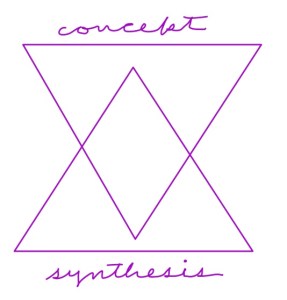
Today, I am recollecting and reflecting on the insights that originally inspired me to draw a diagram that I’ve called “the argyle”.

It was originally meant to show how conceptual wholes and synthesized parts can intersect to produce meaningful systems. In a meaningful system the conception of the system makes the synthesized parts feel necessary and given, because their relationships are pre-determined by the logic of the concept –“Of course it works this way! — but, also, the synthesis is rationally constructed, so even if the concept were missed, the system would make sense — “This is perfectly clear and logical!”.

A meaningful system is comprehended with intuition and reason, or with both together in concert. (I’ve also considered the idea of treating comprehension as being simultaneous inter-illuminating conception and synthesis — instead of as an umbrella term for either conception or synthesis.)


The reason I needed to create this framework was that I’ve found that certain very types of designers (and people doing the work of designers) tend to prioritize concept over synthesis or synthesis over concept to such a degree that they stop reinforcing one another. One one extreme we have the wild genius who conceives a vision of the whole and regards all logic as stultifying formalism that undermines the inspired spontaneity of creation. It does not have to make clear sense if hearts are stirred and wallets open wide. On the other extreme we have the logical organizer of elements who views with suspicion and impatience any delaying attempt to seek an overarching concept to guide the design. After all, logic can get down to work immediately and start making demonstrable progress toward the final goal. If the final output is uninspired and dry — so what? Can the system be figured out with minimal effort? Good enough.

Years later, out of exasperation and a weakness for potty-mouthed ridicule, I developed a second model to describe the failure of merging concept and synthesis — though somehow, until today, I managed to miss the opportunity to explicitly link this failure to synthesis and concept. Instead I linked it to inspired meaning versus practical details.

I called this “the bullshit-chickenshit model”.

Bullshit – Meaningful, inspiring ideas that seem to promise something, but that something can never be fulfilled through any practical action.

Chickenshit – Practical activity that seems like it ought to serve some meaningful purpose, but in reality is pointless busyness.

Bullshit is meaning without practice. Chickenshit is practice without meaning.

But, really, bullshit can be understood as unsynthesizable concept. The meaning is a feeling of vast promise that cannot be applied to any particular.

Chickenshit can be understood as inconceivable synthesis. It is a giant mechanism of logically conjoined pieces that never resolves into a meaningful whole.

Most of what we encounter in the world is pure bullshit and pure chickenshit, and this produces that one-two KO nihilistic punch in the face that sometimes makes us want to burn this whole madhouse down.

*

Finally, I will accept the risk of being accused of bullshit by suggesting that the  Star of David can be viewed as a transcendent argyle, and the ultimate overcoming of bullshit and chickenshit . Even before I was Jewish I conceived it this way, and this insight contributed to my need to be Jewish.

Here, the overlap of concept and synthesis is maximized, and both the depth of concept and extent of the synthesis is felt to exceed the overlap. The meaning of the religious vision resonates in every practical detail of life, but also the doing of every day mundane life is sacralized in Tikkun Olam.

Sacred practicality is practical sacrality.

Practical sacrality is sacred practicality.

This is my own Jewish ideal, and I don’t think it is only mine.

*

Postscript

The “skeleton” of the star — formed by connecting the opposing points of each of the overlapping triangles — eventually became the asterisk “star” in Geometric Meditations.

Tweeting bullshit and chickenshit

I want to see if I can edit down my old bullshit and chickenshit idea to tweet-length.

99% of what goes on is bullshit or chickenshit — purposey blather that can never be put into practice, or pointless activity that only seems to have some purpose.
 
Practiceless purpose is bullshit.
Purposeless practice is chickenshit.
Purposeful practice is good shit.

10,000 foot view

Lately I’ve been reflecting on what strikes me as the most difficult and interesting challenge I’ve faced adjusting to service design after decades of practicing other flavors of human-centered design: the problem of altitude and granularity appropriate to solving service design problems.

In design, thinking about altitudes and zoom levels is common to the point of being a tradition, starting  with the Eamses’s classic “Powers of Ten” film. Given its strategic, integrative, multidisciplinary scope, Service Design is particularly zoomy, so it is unsurprising that altitude-based frameworks and analogies are frequently used in the Service Design world.

As important as it is to understand the value of working at multiple altitudes, it is also helpful to be prepared for the experience of changing altitudes, especially within Service Design’s own peculiar range. For the uninitiated, the shifts in granularity, theme and perspective can be a slightly strange experience. As a sort of expectation-setting initiation, I offer an extended, but hopefully not too labored, analogy.

If strategy flies at 30,000 feet (where the ground is so distant it looks like a map) and we agree most design flies at 3 feet (where the ground is so close and so chaotic it is hard to survey), service design flies at 10,000 feet, approximately the cruising altitude of a single-engine prop plane.

10,000 feet is a very useful altitude that bridges 30,000 foot and ground — clarifying relationships between strategy, operations and the experiences real people (real customers, real employees) have as a result — but flying at this altitude does introduce practical challenges.

First, there is the issue of clouds. At 30,000 feet, the clouds are below you. Standing on the ground, the clouds are above you. But at 10,000 feet you are flying in and out of clouds, which can be very disorienting, in the most literal sense. It can be tricky to know which way you are facing or which way is up. And the view is neither clear nor continuous.  One moment you can see a bit of ground, the next you see nothing but your instruments, and you have to use your memory, imagination and your recording and data-gathering tools to form a sense of the whole. But the understanding that develops from these varying sources has far more structural clarity than you can get from the ground, and more human richness than you can detect way up in the cold, thin air of the stratosphere. To put it all together, though, interpretation is necessary. The picture doesn’t automatically emerge by itself. The heterogeneous parts must be skillfully pieced together into a coherent image.

Second, you are dealing with some odd scales of meaning. Looking down at a town, everything looks miniaturized but still human, maybe even exaggeratedly human because the tedium of life is abstracted away and we relate to it like kids playing with toys. Some homes are big, some are small, some are complexes or towers. Some are arranged in grids, some along windy branches of street bulbing in cul-de-sacs, and some cluster along the edges of lakesides or hills. Some homes have trees or yards, pools, trampolines or gardens, driveways or parking lots. You can imagine what life in the neighborhood might be like. But you can also see the layout of the city, and get a sense of how parts of the town connect up. You can see where the schools, the stores, the churches and the sports fields are. You can see where things have been built up, what has been left in a wild state, and where development is happening.

Now, imagine telling a story about the life you see below, doing justice both to the individual lives taking place in the tiny buildings below but showing how it all connects to form a system… this is not the usual storytelling scale. It is neither intimate nor epic. It must generalize, but without blurring key particularities or averaging individuality into bland anonymity. But if you wish to tell the story of how a town works, or if you want to propose significant structural modifications to the town, this is the narrative scale required. Telling such a story requires thoughtful zooming in and zooming out to show connections between whole and part, connecting fine grain details of breakfasts, meetings and bills, with grander-scale phenomena like demographic trends, commerce and traffic patterns. Translated back to Service Design, this means combining stories of cultural and industry trends, corporate strategies and vignettes from customer’s and employee’s lives to show how these macro-level trends and strategies impact the everyday existence of individual people, and conversely, how the micro-level behaviors impact strategies and generate trends.

Finally, intervening at this height is strange. Many proposals for change fall somewhere between strategic and tactical. They anticipate details of implementation, but without over-specifying them. Specifications are suggestive and provisional and intended more to clarify a problem than provide a solution. Many people find the interpretive latitude confusing: what in the recommendation is fixed and what is variable? If everything is open-ended what use is the recommendation at all? It can all seem vague and insubstantial, yet there is a thrust and lasting momentum in the work that carries initiatives forward and in a direction that benefits both the organization as a whole, its employees and the people it serves. Somehow the recommendations made from this altitude are capable of creating continuity between the grand plans of strategists and the intricacies of implementers on the ground.

The 10,000 view manages to refract the grand plans and sweeping aspirations of the 30,000 foot view into actions on the ground that actualize it and prevent it from remaining mere aspiration and plan. And the 10,000 foot view provides individual actors on the ground a way to relate and connect their efforts to tangible, relatable and realistic goals that connect up with the purpose of the organization.

*

Recently it occurred to me that this 10,000 foot theme is closely related to a framework I found useful and amusing earlier in my career, which I’ve called the Bullshit-Chickenshit model:

Bullshit – Meaningful, inspiring ideas that that seem to promise practical action but never fulfill that promise and never find application.

Chickenshit – Practical actions that seem like they ought to serve some meaningful purpose, but in fact is meaningless and done for no reason.

Bullshit is meaning without application. Chickenshit is application without meaning.

Flying at 10,000 feet helps prevent strategy from losing sight of concrete application and devolving into idealistic bullshit that gets nodded at and then immediately ignored. And the 10,000 foot view provides context for people working on or near the front lines to help them to remember how their everyday work connects up with larger organizational goals, so the tasks don’t lose their purpose and fragment into procedural chickenshit, obeyed, entered into TPS reports, tracked and graphed for reasons nobody remembers.

Problems, living and non-living

I do not do well when my thinking loses direct contact with my own core moral impulses. And by moral impulses, I mean whatever it is behind my mind that invests the world with purpose and value. My moral impulses drive me to pursue problems I feel as live problems.

Problems that feel insignificant to me even while I factually understand  and acknowledge their importance cannot become my problem, no matter how much I want to “own” them. (Unless I somehow manage to link them to one or more of my live problems, something I’ve gotten pretty good at.) These problems are not alive to me, and I have difficulty mustering attention and energy for them, and I can’t make myself remember their content no matter how hard I try. My mind seems to resist and expel “non-living” problems

A decade ago I viewed such problems with contempt and disparaged them as trivvial chickenshit. I viewed my live problems as vastly important, not only for me but for the world.

But now the conclusions I’ve reached pursuing my live problems forbid all contempt for what others value. However, if I am not alert this principled respect can  tempt me to lapse into respecting their contempt for what is simportant to me, and what still seems to me to be the most important problems in the world*. I still do not believe the importance of these problems is an artifact of my personal taste.

I have rejected contempt as a self-defense weapon, so I cannot actively disrespect unphilosophical contempt for philosophy. But that does not entail respecting it.

* I believe every one of the crises the world faces is a consequence of philosophical degradation. Humanity cannot solve its biggest problems because it still misdiagnoses design problems as technological ones. (That is, people tend to fixate on what objective systems need to be engineered, and fail to consider the hybrid objective-subjective systems upon which engineered systems depend. They see the engineered system as primary, and design as a superficial “layer” that can be added and tweaked — not as the foundation upon which engineering problems are defined. And the toughest design problems are tough due to the toughness of philosophical problems that defy crisp design problem definition: “How do we even think about this problem?”

Office politics is real politics

Where a person chooses to work, and how that person relates with others in the workplace shows that person’s deepest political preferences (as opposed to superficial party loyalties).

*

The pragmatic meaning of “respect” litmus test: Some people believe respect means to treat all people as equals (or at least political equals), while others think it means to acknowledge organizational rank (which means accepting inequality), while yet others have personal criteria for earning respect through displays of this or that virtue (industriousness, honesty, intelligence, ingenuity).

It is easy to see how perceptions of “disrespect” can occur across conflicting definition of respect… One person attempts to treat another person as an equal, and this is perceived by the other as insubordinate presumption of an inferior…

Workplace clashes of this kind is the true site of ideological difference (between what Boltanski and Thévenot called “polities“). The appeals that are heard or not heard, the decisions that are praised or condemned, the preferences that are honored or ignored in the daily world of work is the very political substance of a person’s life. “Office politics” is not a metaphor — it is where politics touch down, are lived out as the reality of choice or compulsion.

Compared to the reality of work politics, national politics as reported by Fox News or MSNBC is abstraction. Newscasting might as well be sportscasting. Parties are rival teams playing in distant coliseums. We may have bets placed on one team or another, but mostly it’s just symbol play.

*

Every company is a polis. Beneath the surface of missions and core value (and other such internal-communicationy bullshit), every business has a set of values or rival sets of values, which have been operationalized as work practices, and which are regulated through local political norms. These operationalized values determine the character of the businesses offerings and its self-presentation in the market.


Want creativity for real?

If you want creativity here’s what you really need:

  1. The right approach.
    Business approaches things in a way that’s good for many things, but generally not good for creativity. For one thing, everything’s decided in meetings, through explicit communication by words, numbers and images. Explicit communication will not produce creativity. For another, business loves step-by-step processes. When you say creative process, your average business person will think you’ve got some assembly line string of techniques by which a creation is built up bit by bit. Trying to do things this way guarantees sterility. Creativity requires a lot of pre-verbal (or even permanently non-verbal) intuitive leaps which though testable are not provable, and these leaps cannot be constructed, extracted, extruded or in any way fabricated, but only prepared for, stimulated, coaxed, encouraged — all highly un-macho approaches, which will drive the average exec nuts waiting, and will tempt him reach for the nearest convenient analytical tool to cut through the bullshit and dig out the golden egg.
  2. The right expectations.
    Let’s get this straight up front: Creativity is harrowing. It is non-linear, unpredictable, risky, and in practice often feels like shit. If your organization cannot handle this reality, you’ll have to compete with something other than meaningful differentiation — probably organizational effectiveness. That’s okay. A lot of companies find success that way. And like everyone, you’ll probably talk all about your revolutionary innovations and nobody’ll believe you, and you’ll do just fine. You’ll never be anything like Apple, Nike, Starbucks, Virgin, etc., etc., though.
  3. The right team.
    It is taboo to say this, but it is totally true, and you know it. Most people are not creative. Not only are they uncreative, but they’re creativity poison, because they cannot stand the feeling of being exposed to creative processes and do everything in their power to make that feeling go away (because of all the unpleasant characteristics, listed in the point above). Putting the wrong people on a creative team will make creativity impossible. I don’t know why executives who pride themselves on their cold-eyed realism and their ability to make hard calls and all that go all mushy sentimental on this point, but it would profit them to get realer, meaner and tougher on this point and staff the kitchen with people who can take the heat. But no. Everyone’s packed right in, and people are running around sweating and bitching about getting singed on the burner, and that the raw eggs and the baking soda don’t taste like cake. It’s damn hard to get anything cooked.
  4. The right inputs.
    Many designers secretly or openly detest research. And they should. Because all most research does is tie a designer’s hands by telling them all the cool stuff they want to do won’t fly. It closes down possibilities. But if you were to give designers something that opens up possibilities by inspiring them to conceive totally new approaches they’d eat it right up, because that is what designers live for. The type of research finding that opens up possibilities is an insight. Few marketing/insights departments know how to provide insight, even though they believe that providing customer “insights” is their core competency. When they say “insights” what they mean is facts — information about customers — their stats, behaviors, needs, wants, attitudes, and what have you. Insights are not essentially factual, and they are often not even expressible in language at all. The best source of insights is actually exposure to concrete people, environments and situations, and the best expression of those insights are often not words, graphs, or even cool diagrams, or anything else you might expect to find in a report, but rather ideas on what might work for those people in those environments and situations. But when this happens there’s always some process prig lying in wait ready to tell them they’re “getting ahead of themselves” and that their ideas are premature. They’re wrong. These premature ideas are the expression of having an insight. Don’t get attached to the ideas, but do keep them, because they are raw insight ore that can be melted down, refined and articulated — or simply “gotten”.
  5. The right conditions.
    Creativity is not only ugly and temperamental, it is also needy and fragile. It needs protection, but protection of a kind that seems counter-intuitive. To protect creativity, you have to restrain yourself from protecting the participants from the painful effects. If a creative team is not struggling in the dark, suffering from intense anxiety, infighting, bickering, hating it, with no end in sight until the end is suddenly in sight, they’re not doing anything that will blow anyone’s mind. Let them suffer. But don’t add more pain. Don’t interrupt them with the chickenshit that you think is urgently important. Think of the creative team’s hell as a pressurized tank. Your interruption will puncture it and let out all the pressure and deflate what’s trying to happen. As if this weren’t already too much, there’s one more indulgence you should lavish on your ugly-ass creative process: provide decent space with room to draw, sit, stand, fight, walk comfortably, all with minimal outside stimuli. A rule of thumb: keep creative suffering pure of mundane contaminants.
  6. The right tests.
    The usual tests of validity of ideas in business cannot do justice to creative ideas: 1) demanding analytical justification for why something will work, and 2) submitting it to the semi-informed opinions of people sitting around in a conference room. This procedure is 95% certain to kill off ideas that would work and support crappy ideas that should never have seen the light of day. The only legitimate way to test a creative idea is to prototype it and put it in front of real live human beings. After a prototype test is done and the idea survives it or its suckiness is exposed… then arguments for and against that idea and how it tested can be made.
  7. The right support
    Creative ideas need support before, in the form of these all these items in this list. But also, you need people to make the ideas happen. To execute. Such people are called “executives”. If you throw responsibility on creatives to make execution happen, ideas will always be proved impractical, because execution is a talent of its own. That’s because creative vision and genius for execution are two entirely different talents that do not always coincide in the same personality. One of the great things about business is that we get to combine our talents in ways that cancel out our weaknesses and allow us to accomplish things that would otherwise be impossible. A smarter division of labor based on more realistic psychology, that permits creatives to conceive visionary ideas and executives to execute and actualize them would produce far more brilliant results.

Fable of the Olive Gloss Army Jeep

When my Uncle Steve was in the Army he managed a warehouse. He was responsible for ordering and shipping supplies and managing inventory.

I say he “managed a warehouse”, but actually he managed two warehouses, an official one that belonged to the official Army supply network and a second unofficial gray-market warehouse that was part of a second network supplied by mistakes made by the official supply network’s. And because the official supply network did little but make mistakes, this second supply network was quite robust.

Due to the enormous number of procedures imposed on the network to guarantee maximum reliability and efficiency, the network was impossibly complicated, unreliable and inefficient. And that was the easy part. The processes involved in correcting a fuck-up was ten times more complicated, error-prone and slower than the process of generating a fresh fuck-up.

So, according to Uncle Steve, whenever he was forced to do things the Right Way the official warehouse system would invariably take aeons to complete his order and send him none of what he needed. Instead of attempting to correct the error, he would simply accept the incorrect order, put it into his second warehouse. He’d then use his second supply network to get what he needed a hundred times more reliably in one-hundredth the time.

At some point Uncle Steve started to collect mis-procured Jeep parts, a la “One Piece at a Time”. Soon, he’d assembled an entire vehicle. However, Uncle Steve made one strategic mistake that I feel sure he never regretted: he painted his new Army Jeep high-gloss olive. This extravagant touch attracted the attention of a general who immediately confiscated it for his own use.

The moral of this fable: The Right Way and the Effective Way of getting shit done is not necessarily the same. But even success is won despite the Right Way, once a success is won, the proponents of the Right Way will confiscate the success.

*

Note, proponents of the Right Way confiscate successes as triumphs of the Right Way without the slightest curiosity about how the accomplishment was accomplished.

However, if shit goes wrong the proponents of the Right Way immediately look for deviations from Standard Procedure to explain why things went wrong.

Thus, due to the overwhelming power of selective curiosity, successes are always credited to the Right Way, and failures are always blamed on deviation from the Right Way — when if fact the only role the Right Way really plays in any success being as negligent, ineffectual and otherwise nonexistent as possible.

Continue reading Fable of the Olive Gloss Army Jeep