Category Archives: Star

Single-prompt interview research

A couple of weeks ago, I wrote about a “single-question magic interview“. Placing this question between two genuine interlocutors really does something astonishing, important, rare and rarer by the day.

It made me want to letterpress print this question.

I love words that act directly on a souls.

Whenever I find such words, I want to sink them deep into the surface of paper.

This is my letterpress impulse.


I am now interested in instaurating more single-question interviews. I want to collect and print them.

I will, of course, do this work in faithful, observant service to design praxis, which is sacred and therefore not to be used, but the everse of using. Faithful, observant service to praxis means giving ourselves to our praxis and allow ourselves to be used as its agent, or (as Latour put it) the actant of praxis.


I have a big fear mitigated by some hopeful hypotheses.

My fear is that an increasing number of people have unwittingly been taken by ideological faiths — what some have called “political religions”. Religion, though is not only a misnomer, but a category mistake of the highest pragmatic consequence. Ideologies are fundamentalisms.

Fundamentalism is not religion taken too far, but religion aborted and never reborn in a barren soul.

A fundamentalist faith is (I believe this also came from Latour?) a distinctive attitude toward beliefs. It could be called a belief about beliefs — beliefs being objective facts taken as true.

A genuine religion tries to transcend factual beliefs. It does so by way of a different attitude toward truth, a different mode of of believing, a different configuration of soul, which has believes on a trajectory beyond conceivability, toward “something” ungraspable by the objectively comprehending mind. (See “Religious notes” below for more.)

To a religious soul, fundamentalism is ideo-idolatry, a confused reduction of an essentially inconceivable, incomprehensible reality to a comprehended concept. The fundamentalist worships something that is inside their own heads, and part of themselves. We do this all the time, even in mundane life, when we love an idea of a thing and forget that the idea indicates a reality beyond that idea, whose value is precisely what the idea cannot capture. We confuse mental categories of groups for real persons and love or hate the mental image. We confuse stories for the complex polycentered unfoldings of real events. It’s just how we are, especially when we forget to try to be otherwise.

So — An interview with a fundamentalist, whether that funamentalist adheres to a right-fundamentalism of mis-taken religion or a left-fundamentalism of scientististic psycho-social-political beliefs is unlikely to reveal anything beyond more and more belief system content, which never touches the eclipsed host of these believed-in beliefs.

But it is precisely and exclusively this eclipsed being — this unique intuitive living in the heart of each soul — I want to coax out in these single-question interviews.

Here is where I permit myself the mitigation of hopeful hypotheses.

First, I hypothesize that any apparent soullessness is only apparent, and that what actually happens is only eclipse. A person’s weird, intuitive uniqueness never stops existing, however much it is occluded by opaque belied-in factual content. A belief-system is its own place, which makes heavens of hells and hells of heavens, but these places are not the souls who become imprisoned within them by identifying with what holds them captive. Someone is in there to be sprung.

Second, I hypothesize that the path to an occluded soul (the exit from the cell) is craft. Craft is where a person engages a reality unmediated by language, skin to skin. Where are they blurring the boundaries between their soul, their body, an instrument, and an emerging work in music or visual arts or other flavor of alchemy? Where have they become someone new with someone? Where are they losing themselves in physical exercise? Where do words fail them, precisely where their bodies and souls succeed? I need single questions that puncture belief-systems and get at these experiences.

Third, to get there, I might need to abandon the limitations of conversation. I might need to adopt some of the most radical practices of design research, which preclude the asking of questions. For in generative research we are not interested in answers to our own questions. We are after the implicit questions constituting the subjectivity of our research participants. What questions are relevant to them? To get there we do not ask direct questions, we request lessons. We ask them to teach us about their lives. This is why our research briefs are not defined by questions to answer, but areas of inquiry to learn about.

So the obvious single-question interview about craft might be neither a question, nor an interview. It might simply be:

Please show me your best craft.

In research, things never go as expected. It might be a finished artifact, or it might be a demonstration of doing the craft. Either way, I will have to go to the participant’s place.

The research will have a dual-nature. I am doing the research in order to produce a learning-teaching event, and it will be iterative prototyping testing of the research protocol itself.

The final deliverable of the research will be one or more short, letterpress printable prompts.

These will be used to make some kind of beautiful sacred printed objects, maybe a booklet, a set of cards, a small poster or reference sheet or some combination of these.


A good friend of mine suggested another question:

What is the worst thing that ever happened to you, and how did you benefit from it?

If any researcher or interviewer or front-line service provider or talented conversationalist happens up this, and has a soul-coaxing prompt or question that has worked for them, I am collecting them.

Anyone who contributes a prompt will get a copy of whatever gets printed.


Religious notes:

1.

Generally, fundamentalism believes that a belief system and sound life practice is constructed upon a foundation of concrete fact.

Religion senses a divine ground beneath all objectivity, supporting it, though less solid than water, or even aether. But without this grounding, all fact disintegrates into isolated grains of truth, unable to support even humble truth constructions, much less towering edifices of fact meant to penetrate the ultimate.

2.

Religion believes toward … Toward what is essentially inconceivable, and is not what, but someone who is better but not perfectly characterized as Why or Who. An interrogative combining Why, Who, How, What, Where, When would approximate it better than any one of them. But perhaps refusal to name this interrogative mystery … or even to invent a category for … is a better response. Perhaps we just address … with a simple situating of Nefesh-Ruach in I-here-now: “Here I am.” To say “Hineini” is for Neshamah-Chayah to inhale the pneuma of Nefesh-Ruach into itself, like an atmosphere receives back a lungful of exhaled breath.

3.

All this, of course, is said in the language of my own chosen faith, or, rather, the faith who chose me. Speaking of which, much has been made of the expression “chosen people” but this expression is rarely heard oriented by the best question. It is natural for any envy-inclined mind to hear in this a response to “Which people were chosen versus which other people who were not chosen? A better question would be “Which people made a choice of faith, and which people were made by being chosen by a faith?”

Chosenness does not signify a status: chosen versus unchosen. Chosenness signifies only who chose whom.


Update (August 4, 2026): The goal is “sacred conversation”.

Knitbone manifesto

Part 1: The Hidden Costs of Carrot and Stick Management

Most organizations, as mechanically efficient as they aspire to be, motivate people very wastefully.

Instead of understanding people’s natural intrinsic motivations — their sources of meaning, fulfillment, inspiration, resilience and endurance — they rely on artificial extrinsic motivations. These positive and negative external motivations are often referred to as “carrots and sticks”.

No organization can entirely dispense with external motivations, for the simple fact that many employees are largely externally motivated. But some are not, and when employees who are internally motivated cannot find an outlet for them, and are managed as if they must be externally motivated, bad things happen, which we will discuss.

Let us call the habitual overuse of external motivations “carrot and stick management”.

Instead of creating conditions where people have opportunities to do the kind of work they feel called to do, carrot and stick management prefers bribes, blackmail and psychological manipulation to extract behaviors from their human resources.

Here are some downsides to carrot and stick management:

First, there is the expense of the carrots and sticks themselves. When work is a labor of love, people naturally work tirelessly just for the reward of doing it. When work is a labor of getting paid and not suffering consequences of noncompliance, pay must increase accordingly. Penalizing noncompliance also is not cheap; it requires documented processes. Carrot and stick management squanders cash on artificial motivations required to make folks do what they don’t want to do because natural motivations are lacking.

Second, carrot and stick requires considerable bureaucratic overhead, which is costly to create and maintain. In order to properly reward the desired behaviors and to correct or punish undesirable ones, managers must monitor those behaviors. They must build expensive technologies, establish reporting processes and enforce compliance, because these are dull activities people avoid if they can. Carrot and stick management squanders money and time on artificial motivation technologies and processes.

Third, carrot and stick management wastes an organization’s deepest and best resources — passions that, if channeled into the work, could infuse energy and vibrancy into the organization. Instead these passions are channeled into evenings, weekends, vacations and hopes for a better career elsewhere, where they are valued. The organization, instead of benefitting from these gifts, is resented for rejecting, undermining and obstructing them. And people are left feeling coerced, dehumanized, devalued and unfulfilled, which, for obvious reasons, is corrosive to an organization’s culture and contributes to turnover. Carrot and stick management squanders employees’ and partners’ morale, energy and desire to give.

Finally, demoralized people are demoralizing to interact with. Even if they stay at a job they don’t like and try with all their might to hide their feelings or numbness, they’ll behave in a spiritless, artificial and slightly phony, scripted way. They feel “corporate” in the worst sense of the word, and even the most perfectly executed corporateness is impossible to like. Brands that feel corporate do not inspire positive feelings or personal connection, and undermine brand relationship. Carrot and stick management squanders brand equity.


Part 2: Lessons of the Knitbone

Knitbone is the folk name for the comfrey plant (Symphytum officinale), a plant prized for a great many useful properties.

Traditionally, it has been used medicinally, especially to make poultices which help a wounded body heal itself. A knitbone poultice applied to a broken bone helps it knit itself back together. When my wife gave birth to our first daughter, our midwife prepared a poultice from knitbone we grew in our own back yard garden to help her recover.

But the knitbone used in the poultice had been planted for an entirely different purpose. We planted it in order to improve the soil in our herb garden.

The leaves of the knitbone are extraordinarily rich in minerals, and when they shed and fall onto the ground, they enrich the soil. They create a sort of fertile poultice for the plants around it. A knitbone ripples rings of vitality into all neighboring plants, which is why gardeners plant knitbone throughout their gardens.

Why does the knitbone have this effect on living things? The secret is its roots. When a knitbone is planted, it drops a taproot into the ground, which burrows into the earth, deeper and deeper, sometimes ten feet or more into layers of earth otherwise unreachable, drawing obscure, buried resources up to the sunny surface, where they can be accessed by other plants, animals and human healers.


Part 3: Restart with Whys

My essential service is understanding other people’s driving Why — those natural intrinsic motivations that give a person a sense of fulfillment and life purpose.

Before we can understand what a driving Why is we need to understand what it means to ask a why question.

Because most of us suffer a kind of philosophical color-blindness. Just as the retina of a color-blind person is missing a color receptor, our vision of work is missing a whole category of understanding.

We lack a Why receptor. We have only What and How receptors.

So when we ask Why, we perceive only a What-How answer. We expect an in-order-to response.

Why do you go to work? In order to get paid. Why do you need to get paid? In order to pay my bills and build savings. Why do you need to pay your bills? Why do you need to save money?

Of course, most of what we normally do all day is stuff we do in order to do other stuff, in order to… in order to…

And that is fine, as long as one condition is met: the in-order-to chain is grounded in something that is done for its own sake. It is done for no other reason except its own value.

Here there is no in-order-to. The answer to Why is “I cannot say why.” It is what I do. It is what gives my life purpose. I do it because I love it.

This is what the question Why seeks, and the response cannot be given in language. It is given in feeling and action. Words, at best indicate it, but when they are expected to give that Why, the meaning is lost entirely.

But if a person’s chain of in-order-to is plugged into Why it is all charged with significance. A person feels motivated to do x in order to do y, and z when the connection with Why is felt.

Further, an organization where Why is felt by enough people also enjoys a purposeful culture. Meaning is in the air and infuses the work, even for people who are largely externally motivated. The activities, expressions and outputs of internally motivated people enrich the soil of the organization, and the culture of the organization is nourishing.

People are not motivated by the slogans or mission statements or strategies or justifications of strategies. They are motivated by the energy, the sense of purpose, of importance, the atmosphere of intrinsic motivation.

To achieve this, it is of the highest importance for organizations to start accounting for their stores of intrinsic motivations, and ensure they aren’t wasting or blocking them.

It must understand where these driving Whys may naturally be designed into its operations, so they drive the organization in the direction it is trying to go. And so these driving Whys animate its interactions with customers, who feel and appreciate its charismatic sincerity.

It also must understand where people need these gifts from others — where someone who needs to be needed in a particular way — who wants to give their essential service — can serve another person who needs it. Whether this happens externally — for example when a customer who needs technical assistance is helped by someone who feels personal fulfillment using their expertise — or internally — for example a junior employee is mentored by a senior leader who wants to share her hard-earned wisdom — an internal exchange of value is a win-win.

These win-win points are the energy generators in an organization. This is where the organization provides opportunities for people to give what they need to give, and receive what they need to receive. This is where people feel gratitude and loyalty to one another and to the organization that mediated the exchange.

The choreography of these win-win value exchanges, and all the other value exchanges that power the human interactions that constitute the organization is the very heart of the work service design does.

Service design shapes, as its material, everything that makes up an organization, so it can mediate value exchanges among those who participate in it, whether receiving its products and services (as a customer) or delivering or supporting it. Whatever various materials are used, what sets the whole system in motion — what animates it and gives it vitality — is the exchange of value.

The material of service design is organizations; its medium is exchange of value, and the most vivifying value, the lifeblood that makes the system a living organic system and not a soulless mechanical system, is the driving Whys, the essential services that come from people who have found purpose serving within the organization.

Letterpress magic trick

As promised, I letterpress printed my ASCII Mercury sigil.

Good thing, too! — because after writing “Creation redescription” I was startled to discover that my divine Boolean operations map with uncanny barnumite neatness to this configuration: Plus, divine Andness. Zero, divine Notness. Open parenthesis, divine Orness.

I decided to print the sigil as the oblivion object in a blind spot demonstration, which exemplifies nihilitude (a present nothing which leaves nothing missing, showing very clearly how blindness is the furthest thing from darkness.) It is by nihilitude that the Trickster tricks, so I cannot imagine a better vanishing-appearing figure than Mercury, the trickster angel, for this vanishing act transpiring on my little magic paper strip.

Instructions.

  1. Orient the strip so the asterisk is on the left, and the Mercury sigil is on the right.
  2. Hold the strip arm’s length from your face.
  3. Close your left eye, and keep your right eye open.
  4. Focus your eye on the asterisk, while focusing your attention on the sigil.
  5. Maintaining this dual focus, slowly move the strip closer and closer to your open right eye.
  6. Notice when the sigil is no longer there, absent, while leaving no trace of absence.
  7. Say: “Nihilitude: Nothing is present so nothing is missing.”
  8. Remember that all but the tiniest sliver of reality is submerged in nihilitude. (“Exnihilated”)
  9. Thank God for the shelter of nihilitude, which is the precious gift of moral existence.
  10. Seal it with “Amen.”

There comes a perilous point in a person’s life when the decision can no longer be evaded or postponed:

Either seem sane, or be sane.

Polycentered declarations

The main difficulty I have with esoteric thought is this: I know from direct experience how effective esoteric thought structures are in the dissolution, coagulation, crystallization and stabilization our own souls (psyches) and, consequently, the givenness of the world. Comprehensive conversion — transformation of soul — is a perpetual possibility. This is not even open to doubt, because I’ve experienced conversion phenomena for decades. And people who dismiss this only demonstrate spiritual naivety paired with hubris.

I also know firsthand the role that symbols play in these soul transformations. Radically new truths following from such transformations often emerge first in visual images and diagrams that precede the ability to verbalize the new truth. And when words come, they first come as poetry. Only much later can explicit language be found, but this language still collects around the original structural, visual and poetic core. This genre of revelatory drawing, poetry and writing is hermetic. Again, people who dismiss these things as nonsense only reveal their own limitations.

And I believe that esoteric and normal religious practices can do the same things that thought can. Periodic services and ceremonies, rituals, prayers, forms of mediation as well as religious observances (mitzvot) integrated into everyday life can change or stabilize the givens of reality. And as Susanne Langer taught, our best art is continuous with these religious productions.

To be fully transparent, for me these are less core to my own religious life than thought and symbol work. But they are profoundly important to people in my life that I love most, and by participating in them and bringing my own symbology to my participation, I contribute denser, richer meaning to these practices and receive spiritual communion with others.

Prior to participation in a religious tradition, my spiritual isolation bordered on intolerable. This could be called religious alienation. (Despite what the spiritual-but-not-religious folks believe, serious spirituality craves community of faith. My strong hypothesis is that if this seems otherwise, a person’s spirituality already subsists in an unacknowledged community of faith, perhaps a political one.)

The challenge for me was finding a religious community whose general faith, symbology, practices and metaphysics could accommodate my own faith and its peculiar ways. I absolutely could not belong to any community with anti-intellectual tendencies. I could not belong where devotion or punctiliousness or inchoate mystical feelings of knowingness prevail, and condescendingly assume all religious thinking must be mere theology — a handmaiden of “real” religiosity, or an idle distraction from it.

I found my home in Judaism, where deep study is not thinking about religion, but is itself a core religious praxis on par with prayer. Since the destruction of the Temple and the loss of its material sacrifices, Judaism has sublimated sacrifice and become a radically hermeneutic religion, where lesser understandings are ritually sacrificed and burned on the altar of Machloket l’Shem Shamayim and freed to climb like smoke into the aether, so that insights can descend through the dissipated vapor, back into our souls for recirculation.

This is the religious life as I know it firsthand and very close secondhand.

If you want to know why in Heaven’s name I live a Jewish life, this is my best answer. I am grateful for the miraculous Jewish tradition, and what it has given me (and to all of us, if we are willing to feel the depth and magnitude of gratitude we owe it, instead of stealing these gifts like today’s fashionable anti-Jew “antizionist” prophets of horseshit). And having been adopted into this dysfunctional holy family, I love it in that same stormy, spastic way tight, loving, fucked-up families love — with warmth, fury, irritation, dismay, toughness and hope. And now whatever happens to Am Yisrael — pride, shame, pain, glory, awe, and everything between — directly in my own heart, soul and body, like it happened to me directly, like it happened to my child.

This is identity. It is being a living organ of a living supra-personal body. Anyone who thinks it is a social category imposed on us from without only knows half of the truth, and most very obviously know far less than half of this half.


This section is about what identity is — belonging as an organ of supra-personal being — and what identity is not, a social category that is assigned by oneself or another. It can be skipped, if it bores or offends.

Progressivism is an identity. What progressivists “identify as” is not. This identifying-as is only an expression of one’s Progressivist identity.

The same is true on the right. A great number of Tradcaths and Orthobros express their political identity through some requisite traditional religious devotion.

Progressivists who “identify as a Jew” mainly experience Jewish “identity” as a category assignment within their political identity. Like all members of their faith they are jealous of their category. But they feel directly and spontaneously only the triumphs and humiliations of Progressivism. The daily vicissitudes of the Democratic Party are more viscerally real to them than the existential struggles of Israel. To put it in the starkest terms, November 2024 was personally devastating, where October 2023 was a news story about something that happened far away to someone else.

With respect to the Jewish people — Am Yisrael — Progressivist “as a Jews” are like an estranged spouse with a new lover. Technically they remain married, but their heart belongs to someone new. They are, in fact, Jewish, and nobody can take that away, but they are faithlessly and soullessly Jewish.

They might have a lingering fondness for ethnic Jewishness, and they may feel occasional spasms of ownership, especially if they spot their spouse out in public with someone new (like me, for instance!). “That’s mine, not yours, you lame imposter!” But they have no commitment or loyalty. All that goes to Progressivism. And deep down they know their “as a Jew” identity, is conditional. They must regularly, vocally and explicitly betray their people. Their function is to be human proof-points that Jews, too, can be indifferent or hostile to Israel, and therefore that Anti-Zionism is not anti-Jewish. As long as they keep serving that function, they can be Progressivists in good standing. For now. If the need to renounce antisemitism disappears — and that seems likely — the “as a Jew” Jewish Progressivists will find themselves in the same boat as their disloyal ancestors — abruptly expelled and attacked as outsiders. This pattern has recurred in every European and Arab nation, which of fucking course was precisely why Zionism became necessary. That and two thousand plus years of oppression, persecution and deadly pogroms. To be clear, in this age of exaggeratedly reified metaphor, by “deadly” I mean intentional, non-figurative, non-rhetorical, literal, physical, biological life-ending deaths in large numbers. Folks like Scott Weiner who accuse Israel of genocide, but not enough to satisfy the insatiable hatred of Israel-haters should remember that kapos — even the most willing ones — only delayed their gassing and incineration.

This is how I understand and experience Jewish identity, and how I see it in relation to technically Jewish “as a Jew” Progressivists of Jewish ancestry.


Now I want to speak frankly about important doubts about esoterism, hermeticism and the like. These center on magical claims beyond effects on souls.

Here I have only secondhand knowledge.

To make matters worse, these claims conflict with my metaphysics. These ideas remain outside my faith, perhaps beyond my faith, cloaked in oblivion, as these things are before they reveal themselves ex nihilo.

All this might very well be beyond my reach in the same way my firsthand knowledge of spiritual transformation is beyond the experiential range of the as-yet unconverted or authentic Jewish identity is outside the experience of ethnically Jewish Progressivists.

And I do not mind showing my limits. I am who I am, and I have only come as far as I am today.

I will try to stay faithful to what I know while maintaining as much exnihilist humility as I can toward what may someday come to light. And I will try and re-try never to alienate anyone whose spiritual center is remote from mine.

I will, in other words, respectfully polycenter myself where I am: I, here, now.

And I, here, now believe — humbly and tentatively — that design does, in actuality, and even more in potentia, what magic (also) claims to do.

That is, design forms, reforms, maintains and repairs materials and souls together to instaurate enworldments capable of mediating infinite, finite and definite being. Design circulates the divine light through exchange of gifts.

I have written about design this way before, in a variety of ways, so I will leave things here, compact and opaque and pregnant with hope.

Hineini void

The irresponsible cannot be held responsible for anything but they are guilty of every neglected call to respond.

“Where are you?” . . . Nowhere, never, nobody.

Non-present.


What? You search? You would multiply yourself by ten, by a hundred? You seek followers? — Seek zeros! –”

On decadence

Decadence, etymologically, means state of decay. To decay, to decompose, degenerate, deteriorate, disintegrate.


The overtone in decadence is the dis-integration of subject. And subject is multiscalar.

A person, a family, a community, a nation, an international class or an international order can break down.

One faction is alienated from another, and stops associating or is set against another in conflict.

In an individual, individuum is lost, and becomes multiple individual factions inhabiting a socio-biological dividuum. Each faction does what is pleases in disregard of the others. One faction wants to be healthy and disciplined, but another faction sees a slice of chocolate cake and devours it, health be damned.

A decadent organization, large or small, shatters into mutually alienated and hostile factions that no longer care about the organization as a whole.


A subjective being is decadent when it loses its integrity — its intersubjective integration — and disintegrates into intersubjective anarchy. A We or an I is divided against itself — and often cannot stand other aspects of itself. Self-loathing, other-loathing, convulsive inter-factional alienation and conflict prevail.

A place is decadent when it loses its habitational integrity — its spatial coherence — and is chopped up into dissociated spaces. (Christopher Alexander dedicated his life to repairing places.)

Time is decadent when it is fractured into dissociated instances. Attention is on one thing for a few seconds and then another thing. Momentum is arrested in stop-start motions. Each start lurches in a different direction, in a this-that trajectory. This meeting, then that meeting. This TikTok video, then that video. This topic, then that topic. This election cycle, then that one. This great event, then that one. This mass hysteria, then that hysteria.

There is no evolving flow or development of being through time, across places. Things fall apart. Mere anarch is loosed upon the world, and all that.


There is no time or attention for a long train of thought in a decadent world.

Everything is interrupted mid-thought, mid-sentence.

Only bite-sized bits of information will be eaten. Anything bigger than a bon-bon is too much to chew and bypassed as bad communication.

Only tactic-sized strategies may be followed. The longest long-game is to decide the next move before the problem evaporates into obliviousness.

Perspective is impossible, because each eye spasms toward what is shiniest. Cubist double-vision induces double-think dysunderstandings. A person wants perfect equity and unfettered freedom under theofascist-marxist totalitarian rule… as long as whoever made you feel like something the cat dragged in feels even worse.


A conversation of interrupted sentences is interpersonal decadence.

I am interrupted and interrupted and interrupted by people who increasingly need to not understand the truth.

Radical mid

Periodically, I follow a line of thought so far that I lose touch with my point of departure.

That is, in fact, my goal — my “point of failure” as bodybuilders call it. A touchstone quote from Nietzsche brings me back:

The two principles of the new life.

First principle: life should be ordered on the basis of what is most certain and most demonstrable, not as hitherto on that of what is most remote, indefinite and no more than a cloud on the horizon.

Second principle: the order of succession of what is closest and most immediate, less close and less immediate, certain and less certain, should be firmly established before one orders one’s life and gives it a definitive direction.

What is most certain for a human being is the middle.

Voegelin called this existential middle the metaxy. The metaxy is the threefold present I-now-here.

Between the beings (beyond) who superscend and comprise us and the intuitive sparks (behind) who subscend and constitute us is a tension called I. And it extends indefinitely into an infinite living oblivion, spirit.

Between the future (beyond) which draws us forward into its indeterminate possibility and the past (behind) which constitutes our time is a tension called now. And it extends indefinitely into an infinite temporal oblivion, eternity.

Between the distances (beyond) which stretch outward interminably and substances (behind) which constitutes our immediate environment is a tension called here. And this extends indefinitely into an infinite material-spatial oblivion, apeiron.

For each of us, metaxy collects in mesocosm, suspended between microcosm and macroscosm.

Husserl called this mesocosm in which each and all of us lives lifeworld.

In this lifeworld there are myriad ways to make common sense of things, some better than others.

We make personal common sense across our senses, by seeing, hearing, touching, smelling and tasting “the same thing” in our environment, understanding it synthetically as the common object of our sensory experience.

And we all make interpersonal common sense by talking about and interacting with common objects among us — things we experience together.

As we make sense alone or together, we, ourselves, are shaped. Our objectivity shapes our subjectivity. Or, more accurately, our subjectivities are shaped, and learn to cooperate within a single, multifaceted subject. We learn to understand (to varying degrees and predominance) via all the subjects we learn in school, plus many other, far more local subjects, like the subject of the inhabitant of our home, city, region, nation and internationality.

These subjects and supersubjects are not objects and cannot be known objectively. They are who does objective knowing. The tree of subjectivity is known solely by its objective fruit. Trying to have the tree by possessing its fruit everts being. We compulsively evert being. It is how we are.

Some of these subjects are harmonious with one another and can be used simultaneously and integrally, and some conflict and can only be used serially. The latter are the ones that make us feel self-estranged. We are one person at work, another in public, another with friends and another at home.

But our souls are expansive. We want to extend our I to wider scopes of we. And we want to go deeper to involve finer and finer, subtler and subtler sparks of intuition. We want to integrate with and without, to be self-possessed but to belong. We want to concern ourselves with more varieties of materials networked across greater expanses. We want to come to understand and come to terms with our personal past and the past of our peoples and of our species, of life and of the universe, and we want to see beyond the horizon of the future and anticipate what is in store for us.

As we dilate our souls toward spirit, eternity and apeiron, structures of meaning emerge.

These structures are sacred. They link us to subscendent and superscendent transcendence, which is our source of being. It is a trellis to hold us firm as we extend ourselves, entwine ourselves, ascend beyond the I-here-now point.

Religion is a trellis.

Now I am back in the middle, rerooted in what is closest, most immediate and real.

Missing Da’at

Why is Da’at missing from the classic Sefirot? Why is there an empty asterisk where a Sefirah should be? My tentative answer is: we ourselves occupy that position, and understand from it, in a way that is not itself understood for precisely the same reason we cannot see our own sight or hear our own hearing.

To really understand the Sefirot, we must harmoniously understand the whole Sefirot fourfoldedly (PaRDeS) … from our fourfoldedly whole strength-soul-heart-am / nefesh-ruach-neshema-chayah self … across the interlapping fourfold Assiyah-Yetzirah-Beriah-Atzilut Olamot.

The Sefirot, of course, is a symbol — an intellectual icon through whom we can approach the infinite via the finite. Were it ten-thousand- or ten-billion-fold more complex, it would still be a gross simplification.

The Sefirot is divine design: the optimal simplification.

Letterpress “theory-practice” print

Helen and I spent yesterday parallel printing at the Stukenborg Press with art saint Bryan Baker.

I printed a third, more realistic version of the “Tend the Root” print, requested by Susan and several others who missed the realism of my first screenprinted version, and preferred it to the abstracted asterisk version. I still prefer the asterisk, for visual and symbolic reasons.

More significantly, Bryan has, after months of gentle nudging, managed to persuade me to return to manually setting lead type, which has made my letterpress obsession considerably worse.

(Last time I did this was in 1992, when I handset my wedding invitation, framed with a wood-engraved decorative border of pomegranates and dogwood blossoms. Susan and I pulled a literal all-nighter in the printing studio hand-producing the invitations. Before that, I handset the ingredients of Doritos. Legend has it my Grandpa Dave worked as a typesetter in some kind of association with Frederic Goudy. I’m also apparently somehow descended from someone connected with the founding of Charles Scribner’s Sons. I blame my ancestors for the visceral craziness I feel around books and letterpress. I also blame my design professor Richard Rose for waking this weird impulses lurking in my blood.)

I set one of my favorite aphorisms, frequently misattributed to Yogi Berra:

In theory, there is no difference
between theory and practice,
but in practice there is.

This is one of the wisest and most radically conservative and designerly utterances I have ever heard, and I love it. It demanded to be smushed into the pulpiest of papers.

The everted present

Ray Cummings: “Time is nature’s way of keeping everything from happening all at once.”

“…And,” someone adds, “space is nature’s way of keeping everything from happening everywhere all at once.”

“…And,” another offers, “self is nature’s way of keeping everything from happening to everyone all at once.”

Presence is God’s way of distributing Godself through time space and consciousness.

But within God, everything does happen all at once, everywhere to everyone.

Adonai echad.


The present is the Absolute everted within Itself.

Kabbalistic Geometric Meditations

In my weird little hermetic pamphlet, Geometric Meditations, the stanzas illuminating the star diagram follow a regular pattern. Three levels of indent indicate three levels of reality across three dimensions of being.

First, a dimension is named.

Within that dimension, we encounter reality in a particular way, within a polarity of behind and beyond.

And this encounter is given in a modality of immediate presence.

I now believe that each element of this pattern corresponds to one of the Four Worlds of Kabbalah:

The dimension itself is Atzilut, the realm of pure emanation.

The polarities are Beriah, the realm of intelligibility.

The structure of encounter is Yetzirah, the realm of ideal form.

And the raw present is Assiyah, the realm of the actual.

Representational eclipse

Heraclitus:

One should not act or speak as if he were asleep.

The waking have one world in common, whereas each sleeper turns away to a private world of his own.

Representational thought — our system of beliefs about the world, meant to mirror reality — is a prolonged, elaborate waking dream.

When we are “absent-minded”, interacting directly, intuitively with the world, without mediation of words, we are three-fold present: in time, in place, in self.

This is true even though wordless action, performed without inward “written instructions” leaves no linguistic “paper trail” in our memory. “Words, or it didn’t happen.”

Psychologists and other wordworlders call this wordless immediacy “the unconscious”, the misnomer of misnomers. Words know only words.

There is nothing wrong with a sheer veil of dream, but when dreams grow opaque and eclipse life beyond dream, we will know truths, but we are oblivious to anything beyond truth. Then when we say “it is objectively true” and we say “it is real” we mean the same thing.

An aggressive poke at materialism

It is entirely possible to take science seriously and to respect science as the ultimate approach to generating valid knowledge and technological know-how in its own very important sphere, without succumbing to the temptation to make science (or even the ideal object of scientific inquiry) our metaphysical foundation.

In fact, as Thomas Kuhn beautifully observed and articulated, scientists can function better as scientists if they do not confuse their physics and their metaphysics. Why? Because the most important and consequential scientific work challenges our understanding of the ultimate substances and dynamics underlying reality as we know it. When this understanding collapses and then reconfigures itself in radical and inconceivable ways (as they do during scientific crises and revolutions) those whose entire personal integrity and sanity stand upon these understandings cannot maintain themselves during these disruptions. They cannot avoid clinging to these ideas as if their life depended upon them, because, spiritually, this is literally the case.

The best scientists stand on something else as they work on their basic notions of physical reality, even if that something else is never thematized or analyzed. And frankly, scientific analysis and objective thematization is the wrong form for metaphysical understanding. Such attempts are practical category mistakes of the lowest order, which lead directly to fundamentalism, the objectifying of what must be subjective, the containment of what contains, the eversion of being into thing.


I know very few metaphysical materialists who seem fully aware of the difference between a scientific understanding of matter and the givenness of matter and its source. That source is dark and even darker, where darkness is imperceptible — the glaring mercurial chrome behind sight itself.

What metaphysical materialists worship as ultimate is the scientific understandability, not material mystery, not the materially-inflected transcendence known as apeiron. They cannot know it, but they are, in fact, metaphysical idealists.


Today’s scientistic fanatics could be viewed by material mystics as alchemical fundamentalists.

Chord: Participatory knowing

Three related passages, all hinting at the kind of participatory knowing that enworlds (as opposed to knowing that produces mere worldview). The first is from Martin Buber’s I and Thou, the second from Amos Oz’s A Tale of Love and Darkness and the last from Bruno Latour’s Irreductions.

1.

Every child that is coming into being rests, like all life that is coming into being, in the womb of the great mother, the undivided primal world that precedes form. From her, too, we are separated, and enter into personal life, slipping free only in the dark hours to be close to her again; night by night this happens to the healthy man. But this separation does not occur suddenly and catastrophically like the separation from the bodily mother; time is granted to the child to exchange a spiritual connexion, that is, relation, for the natural connexion with the world that he gradually loses. He has stepped out of the glowing darkness of chaos into the cool light of creation. But he does not possess it yet; he must first draw it truly out, he must make it into a reality for himself, he must find for himself his own world by seeing and hearing and touching and shaping it. Creation reveals, in meeting, its essential nature as form.

It does not spill itself into expectant senses, but rises up to meet the grasping senses. That which will eventually play as an accustomed object around the man who is fully developed, must be wooed and won by the developing man in strenuous action. For no thing is a ready-made part of an experience: only in the strength, acting and being acted upon, of what is over against men, is anything made accessible. Like primitive man the child lives between sleep and sleep (a great part of his waking hours is also sleep) in the flash and counter-flash of meeting.

2.

Two Finnish missionary ladies lived in a little apartment at the end of Ha-Turim Street in Mekor Baruch, Aili Havas and Rauha Moisio. Aunt Aili and Aunt Rauha. Even when the conversation turned to the shortage of vegetables, they both spoke high-flown, biblical Hebrew, because that was the only Hebrew they knew. If I knocked at their door to ask for some wood that we could use for the Lag Baomer bonfire, Aunt Aili would say with a gentle smile, as she handed me an old orange crate: “And the shining of a flaming fire by night!” If they came around to our apartment for a glass of tea and a bookish conversation while I was fighting against my cod-liver oil, Aunt Rauha might say: “The fishes of the sea shall shake at His presence!”

Sometimes the three of us paid them a visit in their Spartan one-room apartment, which resembled an austere nineteenth-century girls’ boarding school: two plain iron bedsteads stood facing each other on either side of a rectangular wooden table covered with a dark blue tablecloth, with three plain wooden chairs. Beside each of the matching beds was a small bedside table with a reading lamp, a glass of water, and some sacred books in black covers. Two identical pairs of bedroom slippers peered out from under the beds. In the middle of the table there was always a vase containing a bunch of everlasting flowers from the nearby fields. A carved olive-wood crucifix hung in the middle of the wall between the two beds. And at the foot of each bed stood a chest of drawers made from a thick shiny wood of a sort we did not have in Jerusalem, and Mother said it was called oak, and she encouraged me to touch it with my fingertips and run my hand over it.

My mother always insisted that it was not enough to know the various names of objects but you should get to know them by sniffing them, touching them with the tip of your tongue, feeling them with your fingertips, to know their warmth and smoothness, their smell, their roughness and hardness, the sound they made when you tapped them, all those things that she called their “response” or “resistance.” Every material, she said, every piece of clothing or furniture, every utensil, every object had different characteristics of response and resistance, which were not fixed but could change according to the season or the time of day or night, the person who was touching or smelling, the light and shade, and even vague propensities that we have no means of understanding. It was no accident, she said, that Hebrew uses the same word for an inanimate object and a desire. It was not only we who had or did not have a desire for one thing or another, inanimate objects and plants also had an inner desire of their own, and only someone who knew how to feel, listen, taste, and smell in an ungreedy way could sometimes discern it.

Father observed jokingly: “Our Mummy goes one further than King Solomon. Legend says that he understood the language of every animal and bird, but our Mummy has even mastered the languages of towels, saucepans, and brushes.” And he went on, beaming mischievously: “She can make trees and stones speak by touching them: Touch the mountains, and they shall smoke, as it says in the Psalms.”

3.

…We should not decide apriori what the state of forces will be beforehand or what will count as a force. If the word “force” appears too mechanical or too bellicose, then we can talk of weakness. It is because we ignore what will resist and what will not resist that we have to touch and crumble, grope, caress, and bend, without knowing when what we touch will yield, strengthen, weaken, or uncoil like a spring. But since we all play with different fields of force and weakness, we do not know the state of force, and this ignorance may be the only thing we have in common.

One person, for instance, likes to play with wounds. He excels in following lacerations to the point where they resist and uses catgut under the microscope with all the skill at his command to sew the edges together. Another person likes the ordeal of battle. He never knows beforehand if the front will weaken or give way. He likes to reinforce it at a stroke by dispatching fresh troops. He likes to see his troops melt away before the guns and then see how they regroup in the shelter of a ditch to change their weakness into strength and turn the enemy column into a scattering rabble. This woman likes to study the feelings that she sees on the faces of the children whom she treats. She likes to use a word to soothe worries, a cuddle to settle fears that have gripped a mind. Sometimes the fear is so great that it overwhelms her and sets her pulse racing. She does not know whether she will get angry or hit the child. Then she says a few words that dispel the anguish and turn it into fits of laughter. This is how she gives sense to the words “resist” or “give way.” This is the material from which she learns the meaning of the word “reality.” Someone else might like to manipulate sentences: mounting words, assembling them, holding them together, watching them acquire meaning from their order or lose meaning because of a misplaced word. This is the material to which she attaches herself, and she likes nothing more than when the words start to knit themselves together so that it is no longer possible to add a word without resistance from all the others. Are words forces? Are they capable of fighting, revolting, betraying, playing, or killing? Yes indeed, like all materials, they may resist or give way. It is materials that divide us, not what we do with them. If you tell me what you feel when you wrestle with them, I will recognize you as an alter ego even if your interests are totally foreign to me.

One person, for example, likes white sauce in the way that the other loves sentences. He likes to watch the mixture of flour and butter changing as milk is carefully added to it. A satisfyingly smooth paste results, which flows in strips and can be poured onto grated cheese to make a sauce. He loves the excitement of judging whether the quantities are just right, whether the time of cooking is correct, whether the gas is properly adjusted. These forces are just as slippery, risky, and important as any others. The next person does not like cooking, which he finds uninteresting. More than anything else he loves to watch the resistance and the fate of cells in Agar gels. He likes the rapid movement when he sows invisible traces with a pipette in the Petri dishes. All his emotions are invested in the future of his colonies of cells. Will they grow? Will they perish? Everything depends on dishes 35 and 12, and his whole career is attached to the few mutants able to resist the dreadful ordeal to which they have been subjected. For him this is “matter,” this is where Jacob wrestles with the Angel. Everything else is unreal, since he sees others manipulate matter that he does not feel himself. Another researcher feels happy only when he can transform a perfect machine that seems immutable to everyone else into a disorderly association of forces with which he can play around. The wing of the aircraft is always in front of the aileron, but he renegotiates the obvious and moves the wing to the back. He spends years testing the solidity of the alliances that make his dreams impossible, dissociating allies from each other, one by one, in patience or anger. Another person enjoys only the gentle fear of trying to seduce a woman, the passionate instant between losing face, being slapped, finding himself trapped, or succeeding. He may waste weeks mapping the contours of a way to attain each woman. He prefers not to know what will happen, whether he will come unstuck, climb gently, fall back in good order, or reach the temple of his wishes.

So we do not value the same materials, but we like to do the same things with them — that is, to learn the meaning of strong and weak, real and unreal, associated or dissociated. We argue constantly with one another about the relative importance of these materials, their significance and their order of precedence, but we forget that they are the same size and that nothing is more complex, multiple, real, palpable, or interesting than anything else. This materialism will cause the pretty materialisms of the past to fade. With their layers of homogeneous matter and force, those past materialisms were so pure that they became almost immaterial.

No, we do not know what forces there are, nor their balance. We do not want to reduce anything to anything else. …

*

We could call this an apeironic materialism, as opposed to a scientistic materialism.

I almost called the latter “physicist materialism” except that Latour and his associates have helped me understand that physics-in-the-making is quite apeironic in its practical attitude. Physics-ready-made, consumed by nonscientists, is the belief content of scientistic materialists, which, ironically, apes materialism: Materials are a matter of bodily engagement and revelation.

Athletes are our most thoroughgoing materialists, and the material they know most is their own bodies in their own material context of action.

Transcendent versus transcendental

I could swear I posted this before, but I can’t find it anywhere: In the star diagram in Geometric Meditations I could have substituted “Transcendental” for Potential, and “Transcendent” for Other. I don’t think I regret writing it the way I did, but I do find it clarifying to note this alternative possibility.

Beliefs versus arguments

Commonsense obliviousness, which can include philosophical commonsensical obliviousness, forgets how pervasive and ubiquitous metaphysical beliefs are.

Whenever we are not thinking phenomenologically — carefully bracketing the sources of our experiences (a very strenuous and unnatural effort!) — and instead take our experiences at face value as experiences of reality, we live metaphysically.

Humans are naturally (and second-naturally) metaphysical.

One of our most primordial, ordinary and important metaphysical beliefs the faith in the reality of past and future. To interpret our memories as records of a reality that has passed, or to understand our imagined anticipations as attempts to foresee a reality to come — both of these take the given present as a part of a larger transcendent reality.

The same goes for the reality of what we experience as phenomena — Kant’s noumena, and the reality of the space within which they extend, which stretches on into the distance beyond our vision, and according to modern commonsense, endlessly into space — these are also metaphysical beliefs. We naturally (and in the case of “infinite” space, second-naturally) go beyond the present givens and take these experiences as parts of a larger transcendent reality.

But our most important metaphysical beliefs concern the reality of other people — not as space-extensive noumena, but as fellow selves. If we take fellow selfhoods as a transcendent reality we begin to see our own selfhood as part of a larger transcendent reality of multiple selves.

And less obviously, our own selfhood is also a matter of metaphysical belief. The nature of this selfhood, and the possibilities of change in one’s selfhood (or even how we conceive selfhood) go far beyond the given present — far further, in fact, than the other metaphysical beliefs.

*

Of course, philosophers love playing the epoché game, bracketing this dimension or that, or all of them together in radical skepticism, or even total Humean solipsism.

But playing around with concepts and seeing what one can construct and argue is not at all the same as changing beliefs. We can affirm or deny assertions all day, and we can claim that we believe or doubt these assertions, but, fact is, whether anyone can prove it or not, these claims are truthful or untruthful reports on our real beliefs.

This line of thought always brings me to C. S. Peirce’s call to intellectual conscience: “We cannot begin with complete doubt. We must begin with all the prejudices which we actually have when we enter upon the study of philosophy. These prejudices are not to be dispelled by a maxim, for they are things which it does not occur to us can be questioned. Hence this initial skepticism will be a mere self-deception, and not real doubt… Let us not pretend to doubt in philosophy what we do not doubt in our hearts.”

*

In the last couple of decades, and especially in the last year I’ve given a lot of thought to the distinction between those thoughts we think with, and the thoughts we merely think about.

The distinction I am making here might parallel that between beliefs and assertions.

How do we know the difference? One test is whether the truths asserted are consistent with truths performed. If one asserts a moral principle, does one act in accordance with the principle, and its full pragmatic consequences — or least hears and responds to appeals? Or does one find reasons to disregard the principle when it makes claims on oneself instead of others. Hypocrisy is a sign that one uses assertions that one does not really believe.

But belief goes beyond simple avoidance of hypocrisy.

I’ve been reading about Habermas, and he talks a lot about the performative truths inherent in discourse. The very act of engaging in discourse implies beliefs, and to deny them is a performative contradiction.

Habermas is a holdout for absolute morality, as something distinct from relative ethics. And his arguments seem to point to precisely my own beliefs on morality, as evidenced by what actually offends me and inspires my contempt — not only of others who offend against me, but also myself when I offend against others. My formulation would almost certainly bother Habermas, but here it is: Thou shalt be fully metaphysical. For me, I feel this belief most intensely with respect to other people, which is a Jewish attitude.

I cannot doubt in my heart that there is something contemptible about treating others as less real than oneself.

I believe that denying the full metaphysical reality of other selves is a betrayal of what we cannot doubt in our hearts is evil — and that any theories that support that effort is also evil. Conversely, any theory that intensifies our awareness that other beings are both real and other is, at least in that respect, good.

Another insight from Habermas has captured my attention is this: morality is not to be determined monologically, but rather dialogically.

And this might reveal another angle for unlocking the full value of the Electrum Rule: “Do to others only what you would have them do to you.” Wouldn’t we always have others involve us in decisions that impact our lives? The Electrum Rule is essentially dialogical, and it is this dialogical reciprocity that drives its non-linear development through degrees of prime.

*

If philosophy aims at changing our beliefs, and we authorize our intellectual consciences to serve as referee, this certainly does raise the stakes of philosophy — but it does it make philosophy less playful? — Only if by playful we really mean frivolous.

Serious players of any game despise frivolity.

Since you asked…

A friend of mine has a habit of sending me emails consisting of simple, beautiful questions.

Years ago he introduced me to Christopher Alexander. When Alexander died I sent him an email, and that started a discussion of Alexander’s later work. This was the context (at least for me) of his latest question-poem:

What is value? Can it be objective?

Does it exist in everything, regardless of whether it is understood or appreciated?

Of course, I had to ruin the glorious simplicity by writing an encyclopedia of a response. The content is mostly the same stuff I am always going on and on about, but these questions inspired a different angle of expression.

But there is one new-ish move here, which might even be an insight: extending the complexity of Bergsonian time to both space (conceived in designerly contextual terms) and — best of all — to self. Just as Bergson conceived now, not as an instant-point, but as a flowing interaction of memories and anticipations, we can see the I, not as an ego-point, but as a subject-complex with flexibly mobile contours subsisting within any number of We’s. This polycentric-self idea may present an alternative to the individualist-collectivist continuum that for many seems the only conceivable possibility.

It all seemed worth posting, so here it is, in mildly edited form.


What is value? Can it be objective?

Christopher Alexander seems committed to objective value, if by objective you mean “inherent to objects” and not relative to a subject. My inclination is to see value as relational — a relation between valuer and valued. I know this is exactly the relativist conventional wisdom what Alexander is attempting to overcome — and I respect that — but I think the real goal here is aesthetic truthfulness (a species of intellectual conscience).

The trusty old Enlightenment method of logical coercion, though, is no match for the might of aesthetic bad faith. Someone who needs to lie about subjective values will become a true believer.

I think this is a religious matter, honestly. Subjective honesty is a virtue we have to cultivate in ourselves, and then we can recognize others who seem to respond to what we experience in similar ways. If discrepancies in response happen, it is more or less impossible to know if someone is subjectively dishonest, or having a strong, sincere idiosyncratic response — or has developed sensibilities beyond our own and are seeing beauty (or other subjective conceptions/perceptions) we haven’t learned to see, yet.

But if we want subjective truth, we’ll stay responsive to our own value-sense, while also looking for ways to transcend our current subjective limits (that is, we will entertain new ways of conceiving and perceiving and see what “takes”).

I think the best reason for this subjective self-transcendence is seeking more accommodating truth, supportive of community of subjective experience with others. Bigger, deeper, richer common sense.

Our We can be more than a mere aggregation of me’s and it’s (in orbit around one’s own I, even — no, especially — when we attempt to efface, factor out, or counter-balance that central I) but this requires a different good faith than the Enlightenment’s objective good faith.

The I won’t disappear. It can’t disappear because it doesn’t appear — any more than our own eyes appear in our vision. The I makes everything else appear. I manifests as a particular everything — what I’m calling enworldment.

We cannot decenter our own I no matter how we try, and when we attempt it, we only conceal its workings for ourselves and delude ourselves into universalizing our own current enworldment as the world per se. Decentering creates more monstrously self-idolizing self-centerings: misapotheosis.

What is needed now is polycentering. Let’s stop scolding our children and saying “you are not the center of the universe.” (When heard phenomenologically, this is manifest bullshit, because of fucking course every child is situated precisely at the center of the universe, and nowhere else, as every child knows!) What we should say is: “you are not the only center of the universe.”

The best alternative to egoist self-centeredness is not the self-decenteredness of altruism, but the self-polycenteredness of participation in community.

*

For some reason Bergson is in the air right now. Many of us are realizing or re-realizing that every instant of time is not an infinitesimal blip on a timeline, but a complex of recollections, concurrences and anticipations. And if we look around us into our environment, as designers, objects are not aggregates of infinitesimal particles, but are environed complexes of contexts, parts, wholes, ensembles. We need to grasp the fact that the I is exactly analogous, in this way, to space and time. An I subsists within a We of present people, memories of people, who I am to others, who they are to me, what I fear from them and for them, what I desire from them, and they from me — an I is a complex of freedom and response-ability. An I is not an ego-point, it is a subject-complex.

That asterisk-shaped continuum with I-Here-Now at the center does not meet at a point but, rather at a bright nebular heart streaming out into things, times, relationships — streaming out, and sometimes withdrawing back into itself to conserve itself, or to gather energy for more streaming-out, or to die as an insular speck.

Does it exist in everything, regardless of whether it is understood or appreciated?

Again, I think value can exist in everything and ideally does exist in everything, but I’m a believer in value inhering not in the subjectivity of the valuer’s valuations or in the objectivity of the valued’s value, but rather in the relationship — in the consummation of valuing. It isn’t subjective or objective — it is “interjective”.

The value is there for us, as a self-evident universal given, if we enworld ourselves in a way that invites valuing relationships. Christians call this “entering the Kingdom of Heaven.”

Argyle

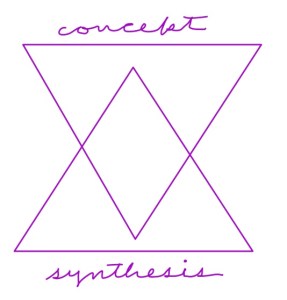
Today, I am recollecting and reflecting on the insights that originally inspired me to draw a diagram that I’ve called “the argyle”.

It was originally meant to show how conceptual wholes and synthesized parts can intersect to produce meaningful systems. In a meaningful system the conception of the system makes the synthesized parts feel necessary and given, because their relationships are pre-determined by the logic of the concept –“Of course it works this way! — but, also, the synthesis is rationally constructed, so even if the concept were missed, the system would make sense — “This is perfectly clear and logical!”.

A meaningful system is comprehended with intuition and reason, or with both together in concert. (I’ve also considered the idea of treating comprehension as being simultaneous inter-illuminating conception and synthesis — instead of as an umbrella term for either conception or synthesis.)


The reason I needed to create this framework was that I’ve found that certain very types of designers (and people doing the work of designers) tend to prioritize concept over synthesis or synthesis over concept to such a degree that they stop reinforcing one another. One one extreme we have the wild genius who conceives a vision of the whole and regards all logic as stultifying formalism that undermines the inspired spontaneity of creation. It does not have to make clear sense if hearts are stirred and wallets open wide. On the other extreme we have the logical organizer of elements who views with suspicion and impatience any delaying attempt to seek an overarching concept to guide the design. After all, logic can get down to work immediately and start making demonstrable progress toward the final goal. If the final output is uninspired and dry — so what? Can the system be figured out with minimal effort? Good enough.

Years later, out of exasperation and a weakness for potty-mouthed ridicule, I developed a second model to describe the failure of merging concept and synthesis — though somehow, until today, I managed to miss the opportunity to explicitly link this failure to synthesis and concept. Instead I linked it to inspired meaning versus practical details.

I called this “the bullshit-chickenshit model”.

Bullshit – Meaningful, inspiring ideas that seem to promise something, but that something can never be fulfilled through any practical action.

Chickenshit – Practical activity that seems like it ought to serve some meaningful purpose, but in reality is pointless busyness.

Bullshit is meaning without practice. Chickenshit is practice without meaning.

But, really, bullshit can be understood as unsynthesizable concept. The meaning is a feeling of vast promise that cannot be applied to any particular.

Chickenshit can be understood as inconceivable synthesis. It is a giant mechanism of logically conjoined pieces that never resolves into a meaningful whole.

Most of what we encounter in the world is pure bullshit and pure chickenshit, and this produces that one-two KO nihilistic punch in the face that sometimes makes us want to burn this whole madhouse down.

*

Finally, I will accept the risk of being accused of bullshit by suggesting that the  Star of David can be viewed as a transcendent argyle, and the ultimate overcoming of bullshit and chickenshit . Even before I was Jewish I conceived it this way, and this insight contributed to my need to be Jewish.

Here, the overlap of concept and synthesis is maximized, and both the depth of concept and extent of the synthesis is felt to exceed the overlap. The meaning of the religious vision resonates in every practical detail of life, but also the doing of every day mundane life is sacralized in Tikkun Olam.

Sacred practicality is practical sacrality.

Practical sacrality is sacred practicality.

This is my own Jewish ideal, and I don’t think it is only mine.

*

Postscript

The “skeleton” of the star — formed by connecting the opposing points of each of the overlapping triangles — eventually became the asterisk “star” in Geometric Meditations.